Sunday, September 10, 2000

Dual: First Cross-Country (ORH-PSF-ORH)

This was my first official dual cross-country (greater than 50 nm from home). It was a good one, with a lot of points to remember, so I better write it down while it’s still fresh in my mind. The cross-country planning went pretty well – I got all the airport info (just PSF and ORH, 64 nm, no third leg this time), estimated based on 90 knots airspeed, and did approximate calculations with zero winds. When I called 1-800-WXBRIEF and got the standard weather briefing with winds aloft, the 3000’ and 6000’ winds were both 6 knots, and the interpolated direction for 4500’ was 25° -- so not much wind and a gorgeous day all the way around (I actually called for a briefing at 8:30 am and was told ORH-PSF was “VFR not recommended” due to low ceilings and fog, so I briefly considered flying to Concord, NH instead – but when Mario arrived, I called again, and PSF was clear, so we stayed with plan A – I should have called the Pittsfield ASOS weather phone line directly – when I did later, it was clear).

The first big problem was that the plane wouldn’t start (it was N47261 – plan was for 661, but it was in the shop for a new engine). The battery was dead – someone had flown a night flight with the alternator light on, apparently (you should look for this and cycle the alternator half of the master switch in this plane). We spent half an hour trying to hand-prop the plane, and it finally turned over (with help from Bob Karman and another CFI, Bill – Mario hates hand-propping but he was the one who finally did it after maybe 20 tries). So we were off at 10:30 a.m. Next challenge was getting to runway 11 – only two taxiways were open (construction), so back-taxi on runway was required, slowing everything down. We back-taxied only part way (tower said expedite, traffic on base!), then turned around and did a short-field take off (stay on brakes, 10° flaps, full power, release brakes). We flew left base and departed downwind to the west (magnetic compass heading 297° according to my nav log). My timer and yoke mount worked well, as did the knee board with my nav log and sectional chart. Mario had his GPS mounted but I could not see the screen – he cheated a couple of times, confirming or correcting my assumed positions (though it was really pilotage, holding a heading, timing, and VOR for 90% of the flight).

Once clear of ORH air space, climbing up to 4500’ cruise altitude (west-bound, even thousands plus 500) we called Bridgeport radio (122.2) to activate the flight plan I had filed on the phone (a first for me). Then we called up Bradley Approach (119.0) and requested flight following (yet another first for me – we were near Tanner-Hiller airport and reported this). Good thing I had recorded all those frequencies on my nav log! They gave us a squawk code and new frequency, which I wrote down and entered (only advantage of 261 is the dual-frequency radio, so you can queue up the next needed frequency). Flight following showed its value very soon, over the Quabbin Reservoir – they called out traffic at our altitude, crossing in front of us, 3 miles – we looked but Mario and I could not see the traffic (I missed my chance to say “no joy” on the radio!). Bradley said “if you don’t have a visual, suggest you expedite descent to 4000 feet” – Mario said “my airplane” and dived us down there pretty fast. We then looked up and saw a 172 passing left to right, just about where we had been, maybe ½ mile away. Close one! We had a good view of Westover ARB to our SW at this point.

I had easily spotted Spencer Airport and the Quabbin south dam, and my next check point was Amherst, Mass – but we also had to avoid Northampton airport, just 4 nm away, due to parachute activity (jumpers away at 8500 feet). I diverted a bit north of my planned track and flew right over the UMass campus – I spotted Becky’s dorm area and took a quick picture.

We had trouble spotting the airport, which is right at a bend in the (Connecticut?) river. I spotted what I thought was the airport, though it looked like a dirt strip (www.airnav.com says it’s asphalt, 14/32, 3500 x 50 feet, oh well).

On the outbound leg, I tended to gain altitude up to 4600 feet or so, but Mario reminded me that holding the planned 4500 and planned heading are especially important with flight following – you must report any altitude changes. Visibility was pretty good from 4500’ though there was a lot of low haze. Our next check point was Albert Airport, a small private strip in the Berkshires. I never saw it, but as a backup, I tuned in the Chester VOR and established that I was on the expected 022° radial. I also spotted a carrot-shaped lake with a dam at its S end about 10 nm SE of our position and noted this on the chart (distinctively shaped lakes or lakes with dams and radio towers seem to be the best landmarks).

Now we were only 17 nm from Pittsfield, and I spotted a large town just over a hill with a radio tower – the chart confirmed that this was Pittsfield, and I spotted the airport just to the SW of the town, but very faint. I think Bradley terminated our flight following at this point, and I tuned in the ASOS to get winds and altimeter setting for PSF. I then called up the CTAF (122.7) and gave our position, requesting the active runway. It was 26 with right traffic. As we got closer, we could see the reason for right traffic – two hefty mountains that would be right in the way of a left pattern for 26 and 32. I swung to the NW, passing over downtown Pittsfield and a high, wooded mountain ridge to enter the pattern on a 45° to the downwind (TPA 2200 feet). With reminders from Mario, I called my position on each leg to Pittsfield traffic (which was nil at that point). I lined up and made a rather long, sloppy touch-and-go, climbing up over the hills that seemed to pop up rather quickly off the west end of the runway. Climbed back to TPA, then turned right to take up my course.

At this point I tuned in and called Bridgeport Radio (Flight Service Stations are called “something Radio” in flight) to close my flight plan to Pittsfield. Two strange things – I got Burlington FSS, and there was a mix-up on whether I had filed out and back (I had not, though I thought I did when I told the weather briefer that I was coming right back, only a momentary stop at PSF – Burlington FSS closed my flight plan for me). So we flew back without a flight plan, but we contacted Bradley on the last-used frequency (good thing I wrote it down!) and resumed flight following.

I got the Bradley guy a little annoyed when I made several course changes over the next few minutes, trying again to swing a little north and avoid the parachuters around Northampton. He had to call me out several times to other planes because my course was changing. We also missed one or two calls for us – bad move – but we were busy and Mario was telling me stuff. We again flew over UMass and I tried to take another couple of pictures, but Mario got annoyed with this, because we also were trying (and failing) to spot an airplane that radar had told us was nearby (our 11 o’clock, climbing through 4500 – we were at 5500’ on the way home, as high as I have ever flown on my own).

Again I got my main checkpoints (Amherst, Quabbin dam) and we soon spotted ORH, a little patch of white just below the haze line to the east. We got Bradley’s OK to switch frequencies briefly to monitor ATIS, then we shortly asked to discontinue flight following so I could call up the tower. We requested a straight-in approach from around 10 miles out (since my return heading was 109 and runway 11 is 110), another first for me. We were told to report 3 mile final (Spencer airport is a good reference for this, it’s about 4 nm west of ORH). It was hard judging my descent from that far out, and I needed to keep my speed up because of following traffic. Tower said to land long (to avoid long taxi on runway) and turn left at taxiway Bravo, way down at the far end of 11, “no delay” due to following traffic (a 172 I think – the C152 is always the slowest thing in the pattern). I tend to land long anyway, so this was no problem!

All in all, a pretty good flight. I did most things right, kept track of my position, flew the airplane well (held 90 knots cruise and was right on 5500’ on the trip home). Now I’m ready for a three-leg cross-country next Sunday in Los Angeles (EMT-F70-CNO, El Monte, French Valley, Chino). Some things to keep in mind for future flights:
• For making minor course corrections when your hands are busy elsewhere (writing notes, tuning radio, etc.), the rudder pedals do a real nice job – smoother than yoke corrections! Of course you have to be trimmed well for this to work.
• It’s important to hold the planned course and altitude if you are on flight following – you want to be a predictable target.
• Call the local weather at the destination to get current conditions, don’t just rely on the weather briefer.
• If you want there-and-back flight plans, you have to tell the briefer this, it isn’t automatic, even if you tell them you are just doing a touch an go.
• Remember sunglasses, especially for the LA flight next weekend!

Time: 2.2 dual, 0.0 solo, TT TBD hrs, C152 at ORH

Tuesday, August 29, 2000

Supplemental: Several August Flights

Wow, I’ve gotten behind in documenting my flights. It’s not that they are routine or anything, but I’m short of time tonight too! Briefly

8/19/00 Dual with Mario, 1.1 hours – Filling in my syllabus items with power-on and power-off stalls and 0.4 hours of simulated instrument with foggles. This was turns to headings, climbs, and descents. This was a pretty good lesson.

8/27/00 Dual with Mario, 1.6 hours – We got carried away! Plan was to practice forward slips at altitude, and we did a little, lining up with some power lines near the Quabbin as if they were a runway, but very high. Forwards slips to lose altitude fast (20 degrees of flaps, though Mario does them with full flaps too, usually not recommended). We also did a little VOR and pilotage practice – it was good visibility but a lot of low haze that made it hard to identify location. If I will go solo to practice area, I have to be able to get back easily! Also tried “Dutch rolls” as Jason had showed me once, cross-control exercise, keeping nose on point, fishtailing with opposite rudder. Ended up talking about and going to the hook-shaped 2500’ runway at Palmer (PMX), and it took me three tries to land on it. Landing illusion from narrow/short runway, you think you are high. I’m spoiled by ORH’s wide 7000’ runway!

8/29/00 Solo landing practice, 0.7 hours in pattern. Frustrating session. Two fairly good landings in left pattern, then passing Hood blimp caused tower to put me in right traffic, and I got flustered and flew downwind too tight and didn’t reverse wind correction. This led to rushed base and high final. Overshot turn to final each time. Grrr! Need more work, and still getting slow on base!!!

Wednesday, August 16, 2000

Dual: Pattern Practice

I've decided to lose the "lesson #" or "flight #" designation since there are now both dual and solo flights, plus some semi-documented flights, so I'll just mark posts as Solo, Dual, or Supplemental.

Mario was out this week because his wife just had a baby (their third, a baby girl). I planned to do some solo landing practice, and although the sky was clear and beautiful, the winds were outside the limits Mario set on my solo flight endorsement (8 knots, 4 knots crosswind) – they were at 300 degrees, but 16 knots, gusting to 23 knots. I was out of luck, but it looked like Doug Rio was just hanging around, so I asked him to fly with me. He said OK. He’s a young Brazilian guy, working on his MEI right now. We took the third C152, one I had never flown, 69L (six-niner-lima in the trade). It’s newer than the others, pretty nice, red-white-and-blue paint scheme, pretty sharp.

The wind gusts blew my around a bit, and it was fairly turbulent. I decided to use only two stages of flaps and tried to fly base and approach at around 70 knots rather than 65 on final. I got slow on one approach, got down to 1800’ on one base leg, and got down below 500’ AGL pretty far out on one final. Line-ups were fair, I’d say. All my usual problems, but slight improvements – I really held 70-75 kts from the numbers to final on all but one approach (on one I was up to 80 kts on part of the final). Still playing with power too much because I’m not consistent and I’m not nailing the 65 or 70 or 75 airspeed I need. ALSO – the view was lovely (not that I notice much in a landing session!), but the sun in the west was BRUTAL flying off runway 29. I need sunglasses, even some clip-ons for the flight bag for now, get Rx sunglasses soon, though! I quit after 4 landings because the sun was just too blinding, especially on climb-out.

It frustrates me that I plan to notice more things in landings – speed, trim, landmarks to hold headings and to turn toward, crosswind correction. But I get this tunnel-vision thing going and focus on 3 or 4 things (it used to be one or two – I read my account of lesson two with Mario, the June 5 evening landing session with two after-dark landings, which MiGMan just posted – man, I was CLUEless back then, just about 10 weeks ago, so I guess I am making progress). Doug was nice, he told me to watch my airspeeds, especially in gusty conditions, and also to watch pattern altitude (usually I’m good on this). Nothing to blame on Rio, though I wish I could have been sharper flying for another CFI.

I received my Jepp knee-board and the timer and yoke mount I ordered. Ready for cockpit management on cross-country flights!

Time: 0.6 dual, 0.0 solo, TT 31.8/1.1 hrs, C152 at ORH

Tuesday, August 08, 2000

Solo: All By Myself

Remember that Eric Carmen song, the one he stole from Rachmaninov? That was me, tonight. This was the first TOTAL solo, and it went OK, though I still can't figure out why I always pull the airspeed back to ~60 kts on final rather than the required 65 kts. Not a big safety issue since the C152 stalls at 35 knots with full flaps, but it's frustrating. When I arrived at 5:00 the ATIS said that wind was something like 260 degrees at 12 knots, gusting to 18 knots. This was outside my 4 knot crosswind limit that Mario endorsed for solo pattern work. So I waited, and by 5:30, the new ATIS said 270 at 8, so this was OK. I got the clipboard and walked out to N67661 for preflight.

I was very careful on the preflight and very deliberate in following EVERY checklist item for startup. Mario arrived with his student just as I was ready to start the engine. He asked if I wanted him to fly a couple with me, but I said no, I was comfortable. “As long as you’re confident – pilot in command!” (Mario’s favorite phrase!). I taxied out and heard ground tell a just-landed Hawker business jet to hold on taxiway delta while I crossed in front of them. As I did my run-up I heard that there were two planes on approach, a Learjet and something else. I called tower with “ready for takeoff, request left closed traffic” when the Learjet was on 3 mile final. I was told “clear for takeoff, no delay” so I taxied smartly (but not rushed!) into place and kept rolling as I pushed full throttle. I didn’t hold the runway heading so well on climb-out, one of my mini-problems. On downwind I watched the Learjet land, a pretty sight indeed. I called as I turned base (controller’s request, rather than mid-field downwind) and was cleared touch-and-go. Surprised I got no “caution wake turbulence” but it was no problem.

I still have trouble with getting slow on base and final, and I don’t really know why. Perhaps as I descend, I have an unconscious fear of “diving toward the ground” (though it’s really a controlled descent), and I hold extra back pressure. This was my problem with Kern – “get your nose down, Bruce!” – last summer. Lineup was poor the first landing, I overshot, but I did better on the other three. I got down to around 60 knots on final and added some power because I thought I was descending to a short position. I’m still really not judging the “point that doesn’t move on the windscreen” very well. I was not right on the centerline at touchdown (problem for narrower runways at other airports), and I had a small lateral drift, but I held it pretty straight. The other patterns and landings were about the same. I’m just frustrated with this getting slow thing. Need to work on this with Mario on Sunday.

On one approach the tower said “watch for landing Cessna on short final – keep your base turn square” meaning that I shouldn’t just swoop down military-style on a curved base-final turn, because the Cessna needed time to complete its touch-and-go. I saw the Cessna and replied “I have the traffic in sight, will keep my turns square for spacing.” Wow, real pilot lingo! I slowed down a bit as well. One time I got “cleared to land” before I even called the tower! I wasn’t sure it was me, so I called him to confirm this. I’m feeling pretty good about the radio work these days – I hear and repeat what I’m supposed to, and if I miss something, I call and ask. I keep it brief even though ORH is hardly a very busy tower (though one guy often covers ground and tower operations).

So I only did 0.6 hours, 4 landings (only $30) -- no sense in practicing something consistently wrong. Figure it out with Mario on Sunday maybe. We also worked on the flight plan for the first official cross-country for some time in the next few weeks (planned ORH to Pittsfield to Orange and back to ORH, though Mario says I could have simply gone ORH-PSF-ORH). Mario also suggested I practice flight calculations with the analog E6B as well as the electronic one (some cruel flight examiners have been known to take your batteries, “it just died, what do you do?”). On the way home I stopped and bought a Minolta 38-90 mm zoom point-and-shoot camera. My old SLR is too bulky, but for flights and air shows, I want better creative control for framing shots!

Supplemental - Cross-country cockpit management (8/9/00) – I just ordered some stuff that will help with the cross-countries, I think: a Jepp tri-fold knee board, a Westbend dual timer (large LCD display and buttons), and a medium yoke mount for the timer (velcro attachment, suitable for Cessna yokes – will also work with GPS if I ever get one of those little guys). This will allow me to keep the paperwork organized in the cockpit, and with the timer on a yoke mount “in my scan” (yeah, right) I will have a better chance at remembering to time my flight legs, resetting the timer for each one. This stuff totals about $80 from Marv Golden Discount Aviation.

I also saw a VERY cool thing on one of the sites (no, not a GPS, though of course I’m already lusting after those!). This was a digital “flight recorder” (FlightCom AiRepeater FC-37, $99) that attaches to the yoke and connects between the intercom plugs and headset. It records the last 60 seconds of audio received over the radio and lets you quickly “rewind” to hear if an ATC call was for you, or to copy down a complex instruction, etc. This could be a real safety aid on IFR flights, though I don’t think I need this sort of thing right now (plus 60 seconds seems a little skimpy).

Time: 0.0 dual, 0.6 solo, TT 31.2/1.1 hrs, C152 at ORH

Sunday, August 06, 2000

Dual: Mini-Cross Country

There have been a lot of days when I've been outside, looked at the sky and thought, "what a gorgeous day -- I wish I were flying!" Well Saturday was one of those days, and I WAS flying. Blue skies with a scattering of puffy white fair-weather cumulus. A little bumpy here and there, but nice. This was all-dual, 1.7 hours C152 with Mario.

I used the airport directory and NY sectional chart to do most of the pre-flight planning for a mini-cross-country, flying ORH to ORE (Orange Muni, just N of the Quabbin) to FIT (Fitchburg, along Rt. 2, over Gardner -- even saw the Gardner VOR) and back over Sterling to ORH. I hoped to detour E to fly over West Boylston and the Wachusett Rsvr., but the first part of the flight took longer than expected. Even though it was too short to be an official cross-country, I figured it would be good practice to get all the info, mark up the chart, fill in the forms, and all that. Then on the flight, following the chart, looking for visual checkpoints, finding and approaching unfamiliar airports, etc. -- just like a real x-country. It's purely a "local" flight for Mario, but I never flew into any of these airports, so it was authentic to me! Total ground distance was only 68 NM, but flying around to properly enter the patterns probably doubled that!

Mario was impressed with my flight planning -- I even got the weather and winds aloft at 3000 feet (only 6 kts at 20 degrees) but I didn't complete the corrections in my navigation log. It was harder than I expected to follow the chart on my lap while juggling 6 or 7 frequencies (ORH's 120.5, ASOS and CTAF for ORE and FIT, CTAF for Gardner when we overflew the airport at 3000 feet, ATIS for ORH, back to 120.5). I also had to look for check point landmarks, plan my entry to each pattern, and fly the airplane! I forgot a lot of stuff along the way, but Mario said I did OK.

Things to note:
• Frequency congestion is a big problem -- 3 or 4 area uncontrolled airports use 122.8 as CTAF, including ORE, and it was very noisy. It took a while to figure out that 32 was the active runway, and it took me even longer to figure out how to enter the downwind at 45 degrees for this since I was approaching the airport on the runway heading! A straight-in approach is bad form at uncontrolled fields (people need to see where you are before you just show up on final). I ended up doing a big circle around the airport which took a long time.
• Watch altitude and airspeed! I climbed to 3300 or descended to 2800 a few times from my planned 3000 (not a normal VFR cruise altitude, but OK for less than 3000' AGL). I should have cruised faster on some legs -- 100 knots maybe. Pitch, power, trim! I should try using the rudders more for slight corrections to course (due to bumps or my wandering attention). If the airplane is trimmed well, it won't climb or drift so much when I'm fiddling with the radios. With flight-following on future x-countries, ATC will expect you to stay at your planned altitude.
• I need to practice forward slips at altitude! I came in high into FIT and Mario told me to do a forward slip. I aggressively pushed full right rudder as he had done earlier, and rolled left at the same time, but I pulled back on the yoke! BAD MOVE. Perfect cross-control set-up for a spin at maybe 1000 feet AGL. People die this way. Fortunately the C152 is forgiving and Mario caught it in time. I need work on this!
• I did OK finding the airports, though I didn't hold my planned magnetic course very well, and I didn't re-adjust the directional gyro to the whiskey compass until I passed Gardner and realized the heading could not be right if I were heading right for FIT (which I was). I got a few of my checkpoints, missed others.
• Over-flying Sterling is a bad plan due to glider traffic there – we stayed further west, passing just east of Mt. Wachusett. We saw two gliders well above us to the SE. There were also "parachuters away at 9500 feet" over ORE. These things made Mario a bit nervous. I was not worried (big sky theory, or maybe just naive?).
• GET ATIS! Before calling ORH on return I forgot to get ATIS until Mario hinted that I had forgotten something. I also need to review arrival and departure plans. It would have been nice to know the active runways before I got so close to ORE and FIT. I wish N67661 had a better radio (one with a button to toggle between active and standby frequencies -- then you can tune in the next one when you have a free moment and just flip it in when needed -- 261 has this but it climbs like a dead dog, so I'll stay with 661 when I can).
• I need a knee board for flights like this -- juggling the loose chart and the other paper where I had written the TPA and CTAF info was distracting. This is a small taste of cockpit management -- I could see this being VERY important on longer x-countries. I need a timer too -- and maybe bifocals! The text on the sectional is small and looking at my watch is distracting, but I need to be timing the legs of the flight, and restarting the timer at each leg!
• On departure, from uncontrolled fields, you need to climb straight out to TPA and depart on a 45 degree turn (R or L) from there. Then turn to heading when you are at least 500' above TPA. At a controlled field, if you get "right turn approved," you can turn to course any time, though you usually should clear the end of the runway first (but OK if you are not at TPA yet).
• Photos were cool since it was such a clear day, BUT... it IS distracting, even when I say "your airplane" for the shot. PLUS I need a point-and-shoot camera with telephoto. The wide-angle Samsung doesn't cut it.
• TRIM, TRIM, TRIM! Both for cruise and for pattern/approach. Trim for the speed I need! I don't do this enough, and I'm not consistent on altitudes because of this. I also play too much with the power, which is bad because it messes up your speed (and trim), which you are counting on to meet your flight plan. There are a lot of things to keep in mind up there!
• Need to practice VOR intercepts and localization in Fly! or X-plane -- I used the Gardner VOR (GDM, 110.6) one time to figure out where were along the first leg (since I couldn't find the Barre race track, my second check point), but I was awkward with it. Another thing to juggle!

There's more I'm sure but I need to get back to work here. I've scheduled my first totally solo flight for tomorrow (8/8) at 5 pm, to practice pattern work on my own at ORH, if the weather is OK and cross-wind is less than 4 knots. This is followed by an hour of ground time with Mario to plan a longer cross-country together. I need to do some prep for this tonight!

Time: 1.7 dual, 0.0 solo, TT 30.6/0.5 hrs, C152 at ORH

Thursday, August 03, 2000

Supplemental: Cross Country Pre-Planning

I'm starting to think seriously about cross-country flying, which will also help me prepare for the written test (charts, plotter, wind, etc.). I scheduled a lesson with Mario for 9:30 am Saturday and left him a voice mail suggesting we do a "mini-cross-country" as a change of pace from all the pattern work. I roughly planned this last night, deciding to fly to Orange (ORE) then to Fitchburg (FIT) and back to ORH. This is a total of 68 nm which should be 0.85 hours (51 minutes) if average ground speed is 80 knots. I picked out check points too. This should be pretty educational for local area familiarization -- pass near a couple of the nearby western airports, over Barre (which shows a race track on the sectional), near the north tip of the Quabbin and into ORE. Then east over Gardner Airport (and VOR, GDM) and into Fitchburg, finally SSW over Sterling, west of the Wachusett, over Holden (possible detour to West Boylston), and into ORH. With landings, this could be up close to 1.5 hours. I think it's a good intro to cross-country flying.

I also found my old Los Angeles VFR terminal area chart and thought about that cross-country on September 17. I think I'll plan to go down to French Valley, which is in the SE corner of the LA terminal chart, near Lake Elsinore, uncontrolled, about 55 nm SE of EMT. Then I'll see if we can stop at Chino on the way back to EMT -- that would be cool to land there myself!

Saturday, July 29, 2000

SOLO! (Lesson #25)


I did it! I soloed in a Cessna 152 (N67661) today (7-29-00) at Worcester (MA) airport, where I resumed my flight lessons with a new instructor in early June. Worcester Airport (ORH) is only 20 minutes from home and is a tower-controlled airport with light airline traffic. I now have a whopping zero-point-five hours as pilot in command. The weather was the usual for Worcester -- cloudy, wanting to rain. Last Sunday we did a "final" test -- 6 landings with no help from my instructor. I did well, so we scheduled a long block of time for Saturday, expecting to solo. I arrived early and spent over an hour with my CFI, Mario, going over my pre-solo written test. That was pretty easy thanks to all the ground school study. Meanwhile, I'm sweating the weather, since ORH started the day with fog and 100 foot ceilings. By 11:30 a.m. it was up to 1100 feet, but we need 1500 to meet minimum VFR (500 feet below any clouds, and pattern altitude is 1000 ft AGL, 2000 ft MSL -- visibility was fine, 10 miles).

By 12:30 it had crept up to 1500 so we decided to try it -- winds were calm to 6 knots and mostly west, little crosswind (only runway 29/11 is open due to construction on 33/15). We took off a little after 1 pm (after a careful pre-flight -- Betty and Caroline had also just arrived to see me off and take pictures -- I sent them down to the approach end of runway 29). We didn't expect to have much time, since a thunderstorm was expected later in the afternoon, and as that moved in, wind and wind-shear could be a problem. One odd thing was that the ATIS frequency was off the air for some reason, so I had to telephone for the pre-flight ATIS info. The tower frequency was a bit scratchy too -- I was glad I reviewed the light gun signals, though I didn't need them.

Mario once again was deliberately silent (and hands off), and I did two pretty decent touch-and-goes. The third was to be full-stop, but I flared WAY too high, bounced a lot and drifted to the right, so he said "let's see that one again." I took it around the pattern and landed OK. We taxied back to Amity, and I left the engine running while Mario gave me some final words and hopped out (he had already signed my logbook and student certificate). His main advice was "no pressure - don't rush for ANYBODY." I got a little stressed last lesson when we were sandwiched between two turboprop commuters and two Pipers in the run-up area. Follow procedures and ATC instructions, but don't rush and forget things!

Once he was out, it seemed very..... routine! I consciously looked down at the empty seat, said "that's odd," finished my checklist, and called ground for permission to taxi. Just following procedures. When I called the tower at the intersection of taxiway bravo and runway 29, I was told to hold short while another small plane landed (a Mooney I think -- I had seen him on base and final so I expected this). This gave me a minute to look for Betty and Caroline -- they were at the fence and Betty waved back to me. Then I got "taxi into position and hold" followed shortly by "clear for takeoff, make left closed traffic." So I took off. This didn't feel the least bit scary or odd to me, though as I expected, the C152 climbs a lot better with only one person aboard! I got maybe 1000 fpm rather than 500 or less with Mario aboard. I was careful to watch my airspeed and to stay coordinated. I remembered carb heat, radio calls midfield downwind, power reduction, and all stages of flaps. I was not as consistent on my turns to base and final as I wanted to be, and I overshot the first one a lot (shallow S-turn back to line up, keeping the ball centered pretty well), the second one a bit, but the third was just right. I picked my landing spots each time, but didn't really stick with the decision (I added a bit of power when I felt like I was getting low a couple of times, though the VASI lights generally showed me as high -- of course high is better than low).

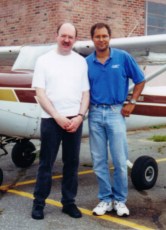
The first landing was a bit "firm" but OK, and I kept good control as I rolled out, raised flaps, killed carb heat, and applied full power for the touch-and-go. The second landing seemed smoother, though it was long because I started to flare very slightly when I was still a bit high (hey, I got 7000 feet of runway to play with). The third landing was full-stop, and I think the flare was good, but when the nose wheel came down, it started shaking like crazy. I pulled back gingerly on the yoke (offload the nose wheel, aerodynamic braking) while I also applied the brakes pretty hard, wanting to exit at the usual taxiway delta. The tower told me to take that exit and contact ground. I switched to 123.85 and reported "Worcester ground, Cessna 67661, clear of the active." They told me to taxi to Amity, so I did. No special words from the tower (I hadn't mentioned first solo to them, though Mario had called them on the phone to let them know to watch out for me). But when I taxied back, Mario was there with a big grin and a Polaroid camera. He said I did a great job. Betty and Caroline showed up a moment later and we took more pictures. It was only three landings, 0.5 hours in my logbook (plus 0.7 more dual), but this was my first solo flight, first PIC time, so it's really REALLY cool.

Now I know I can finish my private pilot, hopefully this year -- sure, I still have a lot to learn, but that first solo is really a confidence builder after decades of dreaming and three years of start-and-stop lessons. In each of the last three springs and summers, I managed to get 6 or 8 hours in, then something would come up (the first "something" was a divorce!). Things have stabilized pretty well now, and I realized in June that this is the one thing I have consistently wanted to do for some 35 years, since first learning the basics of flight in a bunch of Piper Cub orientation flights as a Civil Air Patrol cadet. So I decided I would not put it off any longer. Lifelong dreams are too important!

This is the "solo story" that I posted in rec.aviation.students.

Time: 0.7 dual, 0.5 solo, TT 28.9/0.5 hrs, C152 at ORH

Thursday, July 27, 2000

Supplemental: Pre-Solo Chair Flying

Mario told me to "chair fly" this week, which means thinking through the procedures, mentally re-flying a lesson like the last one, thinking through the checklists, radio calls, taxi, run-up, takeoff, pattern, and landing. I've been studying for the written too -- I filled in most from memory then looked up the FAR's for each answer (not multiple choice!).

I have tried to chair fly with the help of X-plane and Fly! but the behavior is so different from the C152 that I don't think this is helpful for the landing phase. Chair flying with no sim is better! Last night I discovered that Flight Unlimited 3 does actually support separate USB yoke and pedals with suitable edits to the flt3.cfg file, and I got this to work with a lot of finagling (USB situation is messed up -- have to re-plug both devices after every reboot, and their ID's can change, changing what FU3 defines to be device 1 vs. device 2). Although FU3 includes only the Seattle area, it seems to behave and look better than either Fly! or X-plane. So it may be worth spending some time with it -- though Fly! is the obvious thing to use for navigation practice and cross-country preparation, since I do have the Boston area scenery in there. The elevation still doesn't look right, but the Wachusett, major roads, and area airports are in the right places.

Saturday, July 22, 2000

Expecting to Fly (Lesson #24)

Editor's Note: Those lesson numbers are starting to bother me - 24 lessons to solo?!? Yes, and about 28 hours, but 17 of those hours were in dribs and drabs spread across 1997-1999, so I actually soloed after about 11 recent hours. Everyone says you shouldn't care about this sort of thing, but everyone does!

Go for the moon! Well, not the moon exactly, but for solo next Saturday!!! The "final exam" went well with nary a word from Mario once we were airborne (though I did start off poorly by skipping a step in the startup checklist and not retracting the flaps before I started to taxi - FOLLOW THE DAMN CHECKLIST!!!). I did six UNASSISTED landings, five of them pretty good, one of them far off the centerline but recovered on my own (that's useful info for Mario too, to see that I can screw up and still save the landing without too much fuss, though it would be better not to allow that drift -- consistency will come with practice). Mario said everything was good -- procedures, altitudes, descent rates, turns, radio work, EXCEPT…

• Not correcting for the wind on turn from downwind to base -- the tailwind moves you out so you must start the turn earlier and turn MORE than 90º to get established at the right distance (over Worcester State's football stadium - I was way east over downtown Worcester once or twice).
• Getting slow on turn to base - I was at 70 kts when I added flaps abeam the numbers, but I lost it a bit on the turn to base.
• Staying lined up all the way down so the wheels track nicely with no side loads -- getting better but still allowing some sideways drift (once it was a LOT, I probably should have done a go-around on that one).
• I also notice that I got kind of mousy on some of my pattern turns -- trying to keep them fairly shallow, but rolling out early and then tweaking in the rest of the turn -- just fly a rectangular pattern!! As Mario likes to say -- "control the airplane -- YOU are the pilot in command" -- he really likes that expression!" (I actually don't mind it myself).
• If I do a go-around (and don't be afraid to do this if I'm not happy with the approach), remember to establish positive climb and bring the flaps up IN STAGES. Don't want to sink back on the runway from 30 feet!
• ALSO - I was sandwiched between a couple of commuter turboprops ahead and two Pipers behind when I got to the run-up area at taxiway Bravo. I got flustered and wanted to rush through the run-up and taxi fast onto the runway when cleared (the commuter was sitting at the end of the runway with engines running, but I was cleared first, then told to start my crosswind early, at about 1400'). DON'T RUSH IT. When cleared, the runway is MINE, and the other guys, big or small, just have to wait. NO NEED TO RUSH.
• Watch out for wake turbulence if I do get cleared behind a big guy!

So Saturday should be my first solo! I first have to do an hour of ground instruction (at 10 am) with Mario so he can make sure I know enough of the pre-solo written test he gave me (I'm in good shape on this, and he says it's "open book" anyway, with the POH, airport directory, FAR/AIM, etc. available when I need it). I filed a maintenance squawk at M's suggestion because N67661 is using a lot of oil and showing streaks on the cowling. I hope it doesn't have to go into the shop before Saturday. With luck, this will be the last entry in this pre-solo (three year!) flight lesson journal. I'll start a new one Saturday with my very own solo story!

Time: 0.9 hrs dual, TT 28.2, C152 at ORH

Semi-Finals for Solo (Lesson #23)

At the end of this lesson, I discussed the solo plan with Mario. He basically said that NEXT lesson (tomorrow!) we will do pattern work, and he will say and do nothing (short of a real emergency), sort of a pre-solo final exam. He will also give me the pre-solo written test to take home and do, and on the next lesson (soon!) he will grill me on the questions, take me up for a T&G and full-stop, and sign me off for solo! So I am really REALLY close and with luck (weather mostly - crosswinds my big problem), I will solo in the next few days, just short of 30 hours TT (time to switch to a new flight lesson notes file then too).

Today was a two-parter, and fairly long as my recent lessons have been (we seem to have lost the "one hour to stay fresh" idea, though 1.2 or 1.3 is not bad). The first part was in the west practice area, for my first 0.2 hours of simulated IFR, wearing foggles rather than a hood (I could actually see quite a lot of the side and front views). He had me do level flight, turns to specific headings, climbs and descents, with and without turns. I did OK on this stuff (sim experience may actually help on this sort of stuff). I overshot my headings and gained or lost as much as 150 feet (100 is the practical tolerance), but overall not too bad. It was a bit bumpy in spots, but I did OK, didn't overcorrect for it, just rode out the bumps. Things to remember:

• Stay coordinated - step on the ball!
• Don't exceed 30º of bank (standard rate turns in IFR).
• Roll out ahead of the target heading.
• Level off ahead of the target altitude, 10% of the climb rate (50 feet lead for 500 fpm climb or decent).
• Pitch, power, TRIM!!!
• Keep the scan up (I think I did OK on this -- did not seem fixated on the attitude indicator).
I actually liked the IFR stuff, but may try the hood next time.

Then we went back to the airport to practice touch and goes. Flew over town of Spencer to set up the mid-field left downwind for runway 29 (Mario said my pattern entry and setup was "perfect"). Did most of the radio calls except when there were calls to watch traffic and to be #3 after specified traffic which I had to spot and report (lot of traffic today, including two other students doing T&G's, with right as well as left traffic active in the pattern -- controller was busy today). Winds were pretty good, sometimes at 290º, straight down the runway, but I had a crosswind on some landings. I did one really smooth landing, the first one I think, probably my first "greaser." The others were "firm" but I recovered them well, re-flared and held the nose off. Some points:

• WATCH THE WIND ON TAKEOFF - with a wind from the left, I usually had the yoke turned RIGHT at the liftoff point, adding to the wind drift, a mistake. Need to establish the crab INTO the wind as soon as the wheels are off the ground.
• In the pattern, I did pretty well with altitude control, though I still don't have a good feel for when I need to turn greater or less than 90º in my pattern turns due to wind effects.
• Still slow on base and final sometimes (final was usually OK, 65 knots, often 60-65 on base). Mario is still foggy on why I get slow (me too!), but he did mention the need to get the nose down when you add flaps.
• Early lineup was better, and I held the lineup better on most passes, and when I drifted off, I did the corrections myself. Poor wheel alignment on some landings (need to control the airplane all the way down!).
• REMEMBER CARB HEAT midfield when I make the radio call - I forgot a couple of times, though I remembered flaps every time (only used 20º because of the strong headwind on final, low ground speed with full flaps, and also needed to keep speed up due to heavy traffic in the pattern).
• Getting a little better on trim in the pattern.
• WATCH THE TAIL WIND (fast ground speed) on downwind leg -- it went fast and my radio calls were late sometimes (also a lot of radio traffic today, so I had to avoid stepping on others' transmissions).
• IMPORTANT: After touchdown, FLAPS first, then carb heat IN, then full power for takeoff (I skipped the flaps once - dangerous since you can sink when you lose their extra lift, don't want to be airborne before flaps are fully retracted!).
• RIGHT RUDDER for full power climb - keep that ball centered better.
• I was not consistent on the length, altitude, and descent rate for my end-pattern (from abeam the numbers to base to final). Some of this was due to ATC and traffic spacing (slow flight, extend downwind, etc.), but some was just poor airspeed control by me, though Mario commented that I did a nice job each time correcting for the problem and getting the airplane aligned and down. Generally I was high at the start, which is better than low.
• Need to pick my touchdown spot sooner and REALLY aim for it.
• IMPORTANT: Need a review on how to forward slip on final when I end up too high and with less than full flaps!

Overall, a good lesson, and I think I'm justified in pushing Mario a little on the solo plan -- I'm just about ready. I still have this feeling of odd inconsistency -- some things I really have a good feel for (like correcting for various starting points for final, high or low). But other "simple" things seem to escape me sometimes (like which way to bank and press rudder to line up the nose on short final!!!). But the good news is this: I can land the airplane! Not always perfect, but I can land it.

Time: 1.3 hrs dual, TT 27.3 hrs, C152 at ORH