Sunday, June 04, 2000

Back in the Saddle (Lesson #15 - Start Phase 3)

I missed writing up a lesson or two with Kern last summer, I think, plus a rather poor showing in a C152 flight with a CFI named Jim, a real old-timer at Sterling (3B3) when I decided to try that out right when I was moving to this area (I just learned that Jim died of lung cancer last week, leaving Sterling with but one very busy CFI). So here I am in the next millennium, re-immersed in sims and deciding at age 47 (+1 day) that the clock IS ticking, and I better get some real flying in if I ever want to solo and get a PP certificate. I fixed up my insurance situation with a pilot-friendly level term policy. Yesterday we stopped by the Worcester Regional Airport (ORH, elevation 1009 feet) to pick up some info at the Amity Flight School. We were driving on to gigantic Quabban Reservoir, almost to Amherst, on a birthday outing to enjoy the wonderful weather and scenery -- and it turns out I did a power-off stall over the very same body of water today!

I should have reviewed these notes first, but it was a bit impulsive -- I called this morning and scheduled a one-hour lesson with a CFI named Mario for 1 pm. Things ran late due to ATC problems (a no-radio student pilot in the pattern was part of it). So we actually took off closer to 2:30 pm, from runway 29. ORH is a controlled airport with ATIS, ground control, and tower control. I did most of the radio work with guidance from Mario (early forties, African-American who reminds me of Arthur Ashe). Pre-flight, taxi, and runup went OK, a little weak in parts of the checklists as I got distracted by things like a two-engine turboprop airliner landing just in front of us as we held short! Takeoff was OK, though I drifted off the centerline as usual on climbout (hold that DAMN RIGHT RUDDER and figure out a reference point to use during this nose-high climb!). It was a "straight out" (not "direct" as I said on the radio) departure to the west.

By drifting, I ended up directly over the Spencer Airport, not a good place for maneuvers! We continued west (a bit NW) and did some steep turns, 45 degrees right and left. Surprisingly these were OK -- I lost about 150' on one and shallowed the banks a bit. Then he had me try some climbing and descending turns to specific headings and altitudes -- e.g. from 3000' heading north, climb and turn to reach 3500' at 180 degrees (south). I was not good on the timing, but I got better on the 3rd or 4th try -- need to (quickly!) establish the best speed for the climb or descent, THEN dial in the bank angle that will allow you to turn in the time it takes to reach the new altitude. Pretty cool.

Then over the Quabban itself, I did a power-off stall that was pretty good, though I didn't pull back hard enough to get a clean break without a bit of coaxing at the end. Mario said the examiner will most often ask for an imminent stall -- horn, buffet, identify, recover. Safer and quicker for them (full stall could lead to a spin if you botch the rudder too badly, not likely but posisble). Mario was always pointing out airports and good fields for emergency landings -- many out that way and good practice.

Finally I headed back SE toward ORH -- Mario asked me how to get back to the airport, and for once I KNEW! I spotted Mt. Wachusett and deduced the correct heading back to the airport. Spotted it about 6 miles out (it helps that it's on a large hill!). Do I have SA, or what? Well, "not" is probably correct, but in fact I had been looking at the charts a lot and flying test flights around Worcester in the new Fly! flight sim (I installed USGS-based scenery for Eastern Mass, using a freebee called TerraScene - now I need to get the Quabban area files to add to my region, since that's the typical practice area).

We called the tower to report our position over the town of Spencer (first flying there so we would be in position to get a left hand pattern, my preference -- ATC was handling both at ORH, and a glider who strayed too far from Sterling was in a right pattern for runway 29 -- the other two runways are closed for service, to make them wider and longer). We had to set up for a 45º entry onto the left downwind (for 29), which worked out to roughly north from where we were, and we used a pond as a guide to entering at the right (45º) angle. We had to call the downwind and then extend it for an arriving helicopter that I spotted first, low above the Worcester skyline to the east of the airport. I told Mario I was task-saturated with the pattern and traffic (and flaps!) and asked him to call the tower to report base and final. I turned base, rolling out early when I thought Mario said to do so, then corrected. I overshot the turn to final (surprise!) and had to S-turn far to the left to line up (careful to stay coordinated on this turn).

There was a moderate cross-wind that Mario thought I could handle, and I sorta could. He said "push hard right rudder to line up the nose, then bank to track the centerline. This was a cross-control maneuver, a slip really. I started OK but released the rudder too soon, then swayed back and forth with the ailerons, trying to correct the line up. Got the right rudder back in (maybe Mario helped on this part) and thought I was lower than I was, so I flared too high (another shocker!). I slipped some more, lined up, and landed mid-field, using up most of the remaining runway. Not my finest landing, but we walked away from it.

Overall Mario thought I did great considering no real flights since August 1999. I like him -- if I can fly with him once a week, I think I can make real progress. He doesn't seem as slick as a pilot (vs. Kern), but he is a lot more easy-going as a teacher. So now I have maybe 18 hours (and 47 years, as of yesterday!). I think the sim stuff, especially Fly! with the actual area airports, terrain, and navaids, will really help me -- even got rudders again -- Fly! supports multiple game devices, so stick/throttle can be USB and rudder (with a "dummy" stick to make Win98 see it) in the game port. Cool, cool, cool! But I want to fly for real once or twice more before Korea (less than two weeks -- that will be an interesting but nightmarish flight in itself, from Boston to Seoul to Germany and back home in maybe 10 days -- around the world, as they say).

Hey, I can fly today's flight in Fly! Dial in that crosswind…

Time: 1.0 hrs dual, TT 18.1 hrs, C152 at ORH

Tuesday, July 27, 1999

Steep Turns, Distracted Landings (#12 to #14)

I didn't take any notes on this (I'm writing this on 8/3/99 and I have another lesson tonight) -- it was an abbreviated lesson where we spent most of the time practicing 360° turns at bank angles up to 45° -- working on keeping the nose in the right position on the horizon with proper back pressure. Then I did one landing that I barely remember -- I was really distracted by issues having to do with the house addition we're trying to do. I felt pretty frustrated. The 45° turns were fun -- 1.4G so you feel something, but at first I was shy about applying sufficient back pressure to pull us through the turn, so the nose was dropping (and Kern told me to keep back pressure and proper rudder input so we don't get into a "Kennedy death spiral," a reference to the recent crash that killed JFK Jr and his wife and sister-in-law as he tried to land at Martha's Vineyard on a hazy night, flying his recently acquired Piper Saratoga - he regretted this little joke, but graveyard humor is a strong aviation tradition!).

Tonight we'll try some ground reference maneuvers -- I only really did those on one flight with Bjorn, back in March 1998 I think. Plus a landing or two. I really need to focus on holding the proper nose position in my climbing turns (don't let it drop!) and in my descent for landing (70 kt glide, nose DOWN, and down even more with full flaps). ALSO -- make those turns 90° to the runway! I have a hard time judging this for some reason. THINGS TO REMEMBER

TONIGHT…
• Watch for traffic in and around the pattern!
• RIGHT RUDDER only (mostly) on takeoff, and ease it off as speed builds up and control authority improves!
• TRIM for hands-off, power-off 70 kt glide for approach, and don't EVER let the nose get up near or ESPECIALLY above the horizon (too fast is better than too slow)
• Keep the nose UP in climbing turn out of takeoff heading
• REFERENCE points for 90° turns!
• Watch out the front for nose position -- GLANCE left and back for turn control

I KNOW I can do better on this stuff -- it's not that hard!

Editor's Note: This was just about the end of the 1999 "phase 2" -- I was in a new relationship and moving and house buying issues (after the house addition plan fell through) were too distracting and too expensive to allow me to continue flight lessons that year. There was an additional lesson with Kern on 8/3/99 (1.1 hours, traffic pattern and landings at Norfolk), plus a single lesson 8/29/99 at Sterling (3B3) with Jim Davitt (fundamentals, stalls, landing, pretty ragged). Total time at end of 1999 was actually 17.1 hours according to my log book.

Tuesday, July 20, 1999

Bouncing into Norfolk (Lesson #11)

First the good news: I'm landing the airplane pretty much on my own (and my taxi and takeoff skills seem pretty decent now). Five landings this lesson. But the bad news is that I'm wildly inconsistent on some very important tasks, especially my pitch and speed control on final, but also on turns in the pattern, which is kind of weird. Kern said he thought I would have a lesson like this -- hitting the wall or whatever they call it (nope, I didn't really do THAT). But I really need to work on KEEPING THE NOSE DOWN when I'm on final -- it really does look like I'm afraid of hitting the ground in the nose-low attitude that you have in the C152 on final with full flaps (I don't feel afraid -- I believe my eyes and in fact really noticed for the first time whether the touch-down point was moving up or down or stable on the windscreen -- usually moving UP since we were low on every approach, even on Kern's one demo landing).

The weather was really good -- there was a thunderstorm Monday and that left some really nice, stable weather behind it. Once again, practically no wind -- I have my hands full enough without it, but we'll have to deal with crosswinds one of these days. My first takeoff (runway 36) was good (I used a distinctive cloud as a reference point to stay on my runway departure heading), and we turned left 90 at 800' then made a 45 to leave the pattern. We finally headed east (090) for Norfolk airport (32M), which we found easily this time by following the correct (and distinct) power lines, then noting the small pond NW of the runway. I leveled off and held my altitude (2000') and course very well this time.

Norfolk was pretty much deserted and looks more rural and run-down than 1B6. They have a single runway (36) which is shorter and narrower than 1B6, but they also have a taxi way, which saves time and is safer than back-taxiing on the runway. Kern talked me through the pattern entry for 36 after we overflew the airport and he checked the wind sock and tetrahedron (they have both). I don't remember much about the first landing, though I started leveling off at 1000' on downwind rather than 1200' as required, and I don't know why!

In the pattern, for some reason I started lowering my nose a LOT when I would make my turns. I think this is related to loss of attention to nose attitude when I look out the side to try to judge my angle and position to the runway (I also checked the directional gyro for a W heading), but it IS pretty screwy and really bugged Kern. When you make your (CLIMBING!) turn to crosswind after takeoff, you are trying to get to pattern altitude ASAP (1200') and establish a level cruise, but only VERY briefly. Very quickly you are abeam the numbers and need to pull carb heat on, lower power GRADUALLY to idle, establish a 70 kt glide, and TRIM for this (3 and a half turns of NOSE UP TRIM, cranking the wheel BACK or down for this, as I practiced many times in the car).

• Pull carb heat ON
• Lower power to idle
• Hold back pressure to get to 70 kts
• Lower nose VERY little to hold the 70 kts
• TRIM nose up 3.5 turns!
• Start your turn to base!!!

This was happening too fast for me, and as I was trying to judge the position and angle to the runway (hidden by the damn high wing!), I would let my nose go wherever it wanted to go! It even got up above the horizon once or twice, and my speed with no power was below 60, getting near power-off stall speed. THIS CANNOT HAPPEN!!!

So there I was with the nose moving all over -- the trim should have made the 70 kt glide essentially hands-off. Meanwhile, I would have taken too long to get these things set up, so my downwind is extended, and I'm gliding too low to make the runway when I finally turn base and then final, so every time I would have to add a LOT of power to arrest the descent, leading to a roller-coaster-style up-and-down approach, which was bad. Somewhere on final we also crank in FULL flaps (from zero), which requires even steeper nose down attitude to hold the 70 kt glide.

Finally I would be more-or-less stabilized on short final and start thinking about leveling off to fly level to the runway (maybe I'm subconsciously trying to level off way to soon when I let my nose get high in the approach???) and transition to the flare. But my height judgement was poor and twice I bounced without really knowing it - so I continued to pull back full on the yoke, thinking the main wheels are down. Kern knows (and assumed I knew) I had bounced, and he's applying FORWARD yoke, fighting against my back pressure -- he's getting the nose down, trying to keep us from stalling close to the runway! This was all pretty frustrating for both of us, but we kept at it for four landings at 32M and a final landing at 1B6 just about at sunset (really pretty sky on the short cruise back to Hopedale).

Next lesson we will work on some steep turns to try to give me a better sense of my pitch control from external references even when turning. Landings too I assume. I really want to do things right, and I don't know how to make myself do what I know I should (I hold pitch very well on our full-power takeoffs, rotation and climbout at the proper attitude, which is nose HIGH, going away from the ground!). I know pitch controls airspeed -- I know a LOT of stuff but my subconscious seems to have its own ideas when I'm landing. Kern seems baffled and asks me why -- sometimes I want to say "you tell ME why, you're the CFI!" -- but I just need to keep practicing and try to solve all the simultaneous equations until it all clicks for me.

We also had a Piper that we didn't see who came close to landing on top of us on our last landing at Norfolk -- he must have done a straight-in approach and he was not on the CTAF frequency, we heard no Norfolk traffic calls. He saw us and did a go-around, but a pilot walking his dogs while we were fueling told us that he came within 300' of us! Yikes!

Questions for Kern:
1. Full flaps on final vs. putting them in gradually (in stages, as many books show)
2. "Start your turn" calls looked wrong to me -- never looked to me like we could line up from that point - wind correction? Anticipating my slowness to react?

Time: 1.5 hrs dual TT 14.2 hrs, C152 at 1B6

Tuesday, July 13, 1999

Landings and More Landings (Lesson #10)

This was a much better flight overall, though I'm still inconsistent in many ways. I landed three times at 1B6, one of them pretty good. Doing all the flying myself though Kern is still talking me through a lot (though now putting more on me -- are we high or low, OK low, so what? Right, add power or you won't make the runway). My lineups on final were bad -- once I was WAY over to the right and I guess I must have slipped to get back lined up (or maybe Kern helped on that one?). Once I flared quite high and "dropped it in" as they say. Given that I didn't fly at all for three-plus weeks, I think I actually did pretty well.

We started out looking for Norfolk Airport, planning to fill the tanks -- but we never found it! I wasn't worried but it shouldn't be so hard to find airports within 10 or so miles of 1B6. Of course I was just as clueless (but this is consistent with my experience level and the fact that most of my brain is engaged just holding altitude!). Weather was very clear though there was a LOT of sun glare from windshield scratches when flying toward the fast setting sun in the west.

Filled up the first page of my first log book! Yippee!

Points to remember: Trees, climb speed, nose position, rudder use, climbing turn, coordination, judging the point to start pattern turns, toeing into the runway on downwind, setup for 70 knot glide, TRIM!, judging the turn to final, judging too high/low, use of power, FLAPS!, staying lined up with runway, judging when to flare, radio calls, forgetting basic procedures.

Time: 1.4 hrs dual TT 12.7 hrs, C152 at 1B6

Saturday, June 19, 1999

Get Your Nose Down Bruce (Lesson #9)

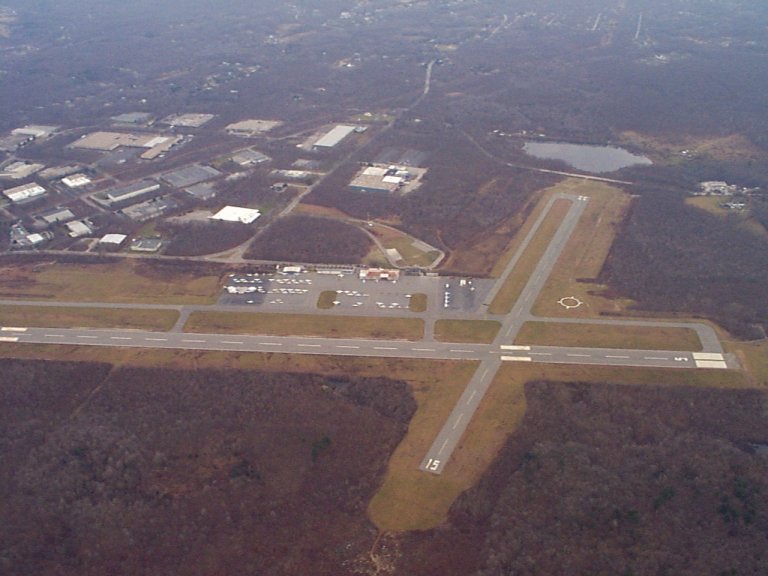
I didn't record any PC notes for this flight on the day I took it (today is 7/14/99). This was right before I left for Japan on 6/20 and it was a busy weekend! I flew with Kern to North Central Airport in RI (SFZ), my first takeoffs and landings away from 1B6. SFZ (shown here) is the nearest uncontrolled airport that has good size runways suitable for early landing practice (and taxiways too - 1B6 requires back-taxiing after every full stop landing). I'll add more later (there are a lot of hand notes in Flight #17, mostly done on the flight to Osaka the next day).

This is where I adopted the Native American name "Get-your-nose-down-Bruce" because I had a tendency to hold too much back pressure when the nose was supposed to be slightly down for the gliding descent in the landing pattern. This was perhaps an "instinctive" attempt to keep from going down too fast, but of course it would slow down the airplane more (not a good thing when you are slow for landing anyway, and close to the ground). I guess I did it a lot.

Time: 1.4 hrs dual, TT 11.5 hrs, C152 at 1B6

Editor's Note: Blogging this ancient history in October 2006, I note that SFZ ended up being the airport where I finally took and passed my check ride in May 2001, so it's interesting that this is where I first started to work seriously on landings. Maybe I'll dig out my old paper notebook "Flight #17" and update with those notes sometime, but probably not! The reason that it was #17 so early in my flight lesson career was that I had been keeping notebooks on my various flight sim experiences since 1994. Flight sims and a lot of reading were the reasons I knew so much of the basic flight stuff even on my intro lessons in 1997, though my practical skills lagged far behind my formal knowledge!

Thursday, June 17, 1999

Practice in the Rain (Lesson #8)

It didn't look VFR to me -- gray and drizzly -- but clouds were all at 10,000 feet, the WX said, so Kern said "we're go." Well, they weren't ALL at 10K -- quite a few floating around at 1100-1500 feet gave us some trouble. Not to mention the C172 was in for 100 hour maintenance, so we flew the little C152 (not a bad little plane, though we were only 60 pounds under max gross weight, and it climbed VERY slowly). Kern took a Boston VFR Terminal Area Chart -- a good idea, it turns out.

Well, it's late, so I don't have time to give the gory details. I did better than last time but still rather spotty on holding altitude and keeping my nose where it should be and my eyes out of the cockpit. Taxied better (need work on even braking). First takeoff was still a bit hesitant (Kern said last flight I "kissed the ground goodbye," touching my wheels lightly after liftoff, insufficient back pressure and a dip in the runway). I did OK on the climbs, some drift, but OK on rudder and coordination I think. Practiced turns (including two 360's), climbs, descents. Little wind and poor ground viz, so we didn't do ground refs today. Visibility started to look QUITE poor in some directions when we reached 1500 feet, but we pressed on to 3000. Ended up west for a while, then south, then north, then south -- then lost!

Not exactly LOST, but neither of us really knew where the airport was, and there were a LOT of clouds around. Kern tuned in the Putnam VOR (in CT, 122.8), knowing the 074 radial points straight to 1B6 (we practiced intersecting a radial, I guess!). But we got confused by the lack of recognized landmarks, the clouds, and the fact that we BOTH forgot we had crossed Rt 140 at some point (we were briefly actually IN some of the clouds -- Kern is instrument rated of course, but it's still not a good idea). So it took a couple of iterations with the VOR to get us back -- Kern was real annoyed with himself. I was never worried especially -- we had a lot of fuel and plenty of places to land if need be. Coolness or clueless? Good question - I really did relax and enjoyed a few minutes of sightseeing while Kern took the controls and tried to find a recognizable landmark (he was not as good as I expected at this, oddly enough, considering his long experience, but in fairnesss, he really doesn't know the Hopedale area that well yet).

ALWAYS carry a VFR Boston area chart, PAY CLOSER ATTENTION to landmarks -- maybe try to say "we're southwest of the airport, maybe 10 miles" to track our position.

Finally Kern talked me through the pattern on a left upwind entry from the south (runway 36). Again, sloppy on nose attitude and altitude control, but I managed, and we both were on the controls for the final approach, flare, and landing. Then we back-taxied and took off for one more time around the pattern -- this time I controlled the takeoff much more smoothly (smaller "pressure like" excursions on the rudder pedals compared to large excursions needed for taxi at low speeds). Overall a very educational and enjoyable flight (finally hit double figures in logged time, barely).

Next lesson in two days! Then off to Japan for two weeks (oy!). I think I may be able to solo this summer if I can make progress as Kern expects. I have my student pilot flight physical scheduled for July 8 in Newton (another $75 for that, but I'll be qualified to solo if I pass). Better check my eyes with these glasses before the test…

Time: 1.2 hrs dual, TT 10.1 hrs, C152 at 1B6

Saturday, May 29, 1999

My "Flight of Passage" (Lesson #7 - Start Phase 2)

It's funny how I met Kern Buck -- in September 1998 I read the book his brother Rinker Buck wrote about their flight across the US in a radioless Piper Cub back in 1967 (Flight of Passage). Then I heard his name in the waiting room at Jiffy-Lube in Milford when we were both having our cars serviced, and I introduced myself (maybe March '99?). We talked on the phone a few times, kinda fun, he was renewing his CFI rating and said we'd go flying when he did.

Well, he did, and we did! Flew a C172 (N738NL) on a gorgeous, windless Saturday morning in Hopedale, where Kern is now a freelance CFI (I guess). We preflighted the airplane together, and I handled all the operations, taxi, and takeoff (he did the radio calls). We worked on the four fundamentals since it had been so long since I flew (climbs, glides, straight & level, turns). He talked me through the approach and I followed through on controls for the landing (he had some trouble finding the airport when we were out west near Mendon -- it's a new flying area for him, he took his IFR instruction at Hanscom).

I did OK on taxi, takeoff (a little hesitant on pulling back at Vr), straight and level, and climbs. Turns were pretty good too, I think, though I gained or lost some altitude on some of them. On glides, I got so hung up on speed that I lost track of my directional control and let the nose wander all over the place. NEED TO HOLD SOME LEFT RUDDER ON A GLIDE. Why??? Shit, I forget!

I don't really have the money for frequent lessons, but I'd like to fly once a month and not worry TOO much about "progress" -- make some slow progress, keep my hand in the flying game. Maybe do self study to take the written exam. Kern would really like to "solo me" this summer or fall, and at $90/hour, we're talking "only" about $1000 for the 10 or 11 hours that this would probably take (I thought I had more time than I do -- there are some unlogged hours, but I probably need around 10 hours of "recent" time to really be able to solo. I'd also have to get my medical exam -- don't have to take the written before solo, but that would be cool too). It's "only" $1000 but with everything else I'm doing, it's kinda tough. I should really level with Kern on this -- if he wants weekly flights, he needs to get an additional student, not just me!

I like Kern -- he's an interesting guy, certainly, and seems OK as a CFI, pretty relaxed, but not as relaxed as Bjorn. Of course this was our first flight, and his first flight in a long time as CFI (though he has 2000 flight hours, 1000 of them as CFI). We need to get our goals in synch -- I'd love to fly a lot and solo and get my ticket ASAP, but money is too tight for this right now.

Follow-up: I spoke with Kern about scheduling more lessons. During the call, Kern told me that he thought my flying was really good, and that I knew most of the basics pretty well. He said I really just need work on integrating it all, practice and pointers, and that within about 2 lessons we could start to work on takeoffs and landings, with the idea of solo by the end of this summer! That would be so cool! Trouble is that 8-10 hours will cost $800-1000, and with house plans underway, money and time are tight. BUT IF NOT NOW, WHEN? Kern says if you love it, then find a way to do it -- don't keep putting it off. And it's important to fly regularly, like once a week (travel permitting) so I don't keep backsliding and having to review for half the lesson. I'M GONNA TRY FOR IT!!! Take a look at the budget...

Time: 0.9 hrs dual TT 8.9 hrs, C172 at 1B6

Sunday, March 29, 1998

Going in Circles (Lesson #6 - End of Phase 1)

Bjorn was back from Sweden and the weather looked good for the weekend (unseasonably warm, in the 70’s), but Saturday afternoon was too gusty to fly. So I rescheduled for Sunday morning at 8:30. It was still a little windy and picked up through the flight, though above 3500’ it was pretty smooth. I was late in rotating on the takeoff (watching for 60 mph for Vr, but the nose wheel started to shimmy – it was actually a crummy takeoff, and a sign of things to come!). I thought I would do a little better because I had spent about an hour on Saturday sitting in the cockpit of the 172 to be more familiar with the instruments and controls. It didn’t help!

When we got to 3000’ (over Woonsockett, which I incorrectly guessed to be Mendon! No SA either!), Bjorn had me start doing some steep turns, 45° left and right, trying to return to my starting point in heading without losing altitude. I sucked at this! My big problem was overcontrolling and using jerky, fast inputs on the wheel. Second, I was not really aware of what the “sight picture” should be out the window, and I kept looking at the attitude indicator. I applied control movements sequentially rather than simultaneously, and I failed to notice when the nose was going down from insufficient back pressure in the turn. Sometimes I would overbank (30° normal turns don’t require much opposite aileron, if any – but at 45°, the airplane wants to keep rolling into the turn, so you have to apply some opposite aileron to hold the 45°, plus jimmy the wheel around to keep the wind from knocking you out).

The big problem with the nose dropping was caused by not applying smooth back pressure at the same time as I moved from 30° to 45° in the bank – then I would have to roll BACK to 30, apply back pressure, then go to 45 again and try to hold it. I felt like a one-armed juggler – I just could not keep all these things in mind at the same time! Grrrr!!! Bjorn did a couple of demos and made it look easy – on the first one, we felt a little bounce of turbulence as he returned to the exit point he started and went through our own wake.

I need to ask him to get the black disks to cover some of the instruments to force me to be more “eyes out of the cockpit.” Maybe I also need a sort of review lesson of basic stuff – standard turns, straight and level, setting up for climbs and dives. This three or 4 weeks between lessons is pretty frustrating, but that’s life as we know it. The budget will not take much more than this.

On the way back to 1B6, we went through a simulated emergency landing setup, cutting power and using the airport as our emergency field. The one thing I did well was setting up for best glide speed at 75 mph. But I let the wind drift me all over the place, and we were way too high and fast for the landing, so I did a go-around (probably my first – maybe 200’ above the runway, apply full power, establish a climb – I forgot to raise the flaps, of course!).

I really do need to go in a day or two before each lesson and sit in the airplane and rehearse the procedures we will do. Next up is slow flight (again!). At this rate, I’ll be doing landings, oh let’s see, when I’m 63?!?!

Time: 1.0 hrs dual TT 8.0 hrs (C172 at 1B6)

Editor's Note: With the divorce and other stuff going on, money and time just got too tight, and I didn't take any more lessons with Bjorn - in fact this was the last lesson until May 1999! This was the end of my "phase 1" attempt to get my pilot's license (1997-1998) - there would be another brief attempt in 1999 and the big push that finally succeeded in 2000-2001.

Tuesday, March 10, 1998

Ground Reference (Lesson #5)

I lucked out on the weather – there was a big thunderstorm last night, but this morning it was OK. It was quite windy and the cloud level was fairly low but still OK for VFR. Bjorn was very cool – a much more patient and understanding instructor than Jason (not burned out yet?). He suggested ground reference maneuvers, which were fun!

Preflight and run-up were fine, and I’m taxiing more smoothly than before, despite the long layoff (the airplane feels at least a little familiar now). There was a fairly strong crosswind from the west, and we took off to the south (18, left end of 1B6) then departed west (right turn) toward Mendon and Upton. The crosswind really blew me around on takeoff – Bjorn prompted me to crab into the wind and hold right rudder while on full power. I leveled off at 1500’ and looked around for a rectangular field to use for pattern work. I had some problems with the strong wind from the west (I wasn’t really visualizing this wind, I was just using the ground reference points and horizon to try to keep a constant distance from each leg). I was rather sloppy on this, but I got better after a couple of turns around the field, gradually steepening or shallowing the bank on the upwind or downwind).

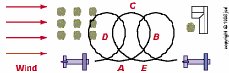
I did a lot of turns around a point, using a comm tower near a distinctive silo, and at first, I did something like the picture shown above, from John Denker's See How It Flies. I should re-read the various chapters on maneuvers. After a while I did see the pattern of how to vary the bank continuously vs. the wind.

Finally we went over to Rt. 146 and did a bunch of S-turns across a road. This really IS fun! I did pretty well overall, sometimes undershooting the road (e.g. being perpendicular to the road before I was over it), sometimes starting the outside of the S too early or late. But I made a couple of turns that Bjorn said were really good, even holding altitude.

In general, though, I did NOT divide my attention that successfully. He kept saying, “keep your nose up” and I would gradually lose or gain altitude in these maneuvers (between 1000’ and 1700’ vs. nominal 1500’ we wanted). I got real steep a few times when I was too far from the reference point, and lost sight of it. Also on the approach back to 1B6, I did OK on turn to base, but overshot the turn to final again, doing a steep turn back when I was slow and low power -- NOT GOOD! I got a bit nervous with the crosswind, fearing I would not make the lineup, so I asked Bjorn to take over after I lined up, and I followed through.

He made a decent but fast and somewhat floaty landing to the north (36), with a LOT of crab required on the final, and a lot of cross-control slipping on short final (that felt really strange, I recall – I could really feel the slip as he used opposite rudder and aileron to stay lined up with the runway in the strong crosswind). Now I don’t want to wait 5 or 6 weeks for the next lesson – I could make some progress on landing now that I’m getting a better feel for controlling the airplane w/r/t the ground, even with a stiff wind. I was a happy camper. Bjorn is off to Sweden until 3/26. Jeff says I still have over $600, but I don’t think this is right. He promised again to send me a full accounting.

One other thing: I really felt like I was flying the plane “naturally” or something for a few minutes during this flight – doing what I had to do without thinking about the mechanics. Not quite Zen-like, but getting a feel for flying (and only in brief bursts). I wish I could fly every week now, but I can't.

OTHER PROBLEMS: Still rather dead on my feet when I wasn’t thinking of the rudders or looking at the ball. Weak on trim. Unaware of most instruments. Looking at RPM’s too much when I adjust the throttle. Not looking for traffic very often. Better on external references for attitude, but still not good. Bjorn suggests that I spend some time (for free) sitting in the cockpit of the C172 on the ground, memorizing instrument positions, switches, and procedures. He said you could even rehearse stalls and landing approaches, like a fixed simulator – hey, maybe I could bring my notebook PC in there…

Time: 1.0 hours dual TT 7.0 hrs, C172 at 1B6

Tuesday, February 03, 1998

The Separated Man Also Rises (Lesson #4)

The separated man also rises! This was my first lesson since the whole separation (and soon divorce) mess started in fall 1997, just after I got back from Germany. Quite an interruption there (of a lot of things!). A few little changes at Hopedale too – Jason and Joe both gone south, and Jeff has a new CFI, Bjorn, a very young Swedish guy who is really nice and has excellent English. I preflight checked the C172 (the C150 is gone too – bummer), and also did all the taxiing, the takeoff, and climbout (let it get a bit nose high/slow on the climbout). It felt OK. Scenery was different with snow and no leaves – a lot easier to spot the airport!

I did OK on straight and level, climbs, turns, etc. except for a tendency to drift right (too much rudder and/or not adding left aileron to compensate for the right rudder held against full-power engine torque). I also looked at the instruments too much and trimmed too early. Bjorn had me do some slow flight, which was pretty good once I got the power and trim set right. I asked for stalls and he let me do power and power off stalls. I let the nose come up too high after one and got a secondary stall (actually was close and Bjorn pulled it back the rest of the way to show me – the left wing dropped a lot, but we recovered fast before any spin possibility – I also allowed the nose to drift high after recovery other times, and was off on timing the raising of flaps. NEED TO GET A POSITIVE RATE OF CLIMB BEFORE CUTTING POWER OR RAISING THE NOSE TOO HIGH.

I was able to spot the airport better with water tower landmark and black strip vs. white field. He talked me through the turns as we glided down to pattern altitude (1300 feet). He let me do the final approach, but I turned from base to final WAY too late (I thought he would take it at that point). Had to make S-turns and come in rather steep and fast – Bjorn took the plane and saved the landing, but touchdown was beyond mid-field (still plenty of room to stop, but not exactly slick).

I’m thinking I’ll try to do maybe a lesson a month – slow progress at that rate, but better than zero, and all I can likely afford (if that!). I like Bjorn – hope he sticks around a while. I should start my ground school study again, but I’m too busy looking on the Web for prospective dates! I’m finding women who sing, but so far none with an airplane! Maybe I should join a pilot’s club of some sort?!?!

Time: 0.9 hrs dual TT 6.0 hrs (C172 at 1B6)