Mario told me to "chair fly" this week, which means thinking through the procedures, mentally re-flying a lesson like the last one, thinking through the checklists, radio calls, taxi, run-up, takeoff, pattern, and landing. I've been studying for the written too -- I filled in most from memory then looked up the FAR's for each answer (not multiple choice!).
I have tried to chair fly with the help of X-plane and Fly! but the behavior is so different from the C152 that I don't think this is helpful for the landing phase. Chair flying with no sim is better! Last night I discovered that Flight Unlimited 3 does actually support separate USB yoke and pedals with suitable edits to the flt3.cfg file, and I got this to work with a lot of finagling (USB situation is messed up -- have to re-plug both devices after every reboot, and their ID's can change, changing what FU3 defines to be device 1 vs. device 2). Although FU3 includes only the Seattle area, it seems to behave and look better than either Fly! or X-plane. So it may be worth spending some time with it -- though Fly! is the obvious thing to use for navigation practice and cross-country preparation, since I do have the Boston area scenery in there. The elevation still doesn't look right, but the Wachusett, major roads, and area airports are in the right places.
Thursday, July 27, 2000

Saturday, July 22, 2000
Expecting to Fly (Lesson #24)
Editor's Note: Those lesson numbers are starting to bother me - 24 lessons to solo?!? Yes, and about 28 hours, but 17 of those hours were in dribs and drabs spread across 1997-1999, so I actually soloed after about 11 recent hours. Everyone says you shouldn't care about this sort of thing, but everyone does!
Go for the moon! Well, not the moon exactly, but for solo next Saturday!!! The "final exam" went well with nary a word from Mario once we were airborne (though I did start off poorly by skipping a step in the startup checklist and not retracting the flaps before I started to taxi - FOLLOW THE DAMN CHECKLIST!!!). I did six UNASSISTED landings, five of them pretty good, one of them far off the centerline but recovered on my own (that's useful info for Mario too, to see that I can screw up and still save the landing without too much fuss, though it would be better not to allow that drift -- consistency will come with practice). Mario said everything was good -- procedures, altitudes, descent rates, turns, radio work, EXCEPT…
• Not correcting for the wind on turn from downwind to base -- the tailwind moves you out so you must start the turn earlier and turn MORE than 90º to get established at the right distance (over Worcester State's football stadium - I was way east over downtown Worcester once or twice).
• Getting slow on turn to base - I was at 70 kts when I added flaps abeam the numbers, but I lost it a bit on the turn to base.
• Staying lined up all the way down so the wheels track nicely with no side loads -- getting better but still allowing some sideways drift (once it was a LOT, I probably should have done a go-around on that one).
• I also notice that I got kind of mousy on some of my pattern turns -- trying to keep them fairly shallow, but rolling out early and then tweaking in the rest of the turn -- just fly a rectangular pattern!! As Mario likes to say -- "control the airplane -- YOU are the pilot in command" -- he really likes that expression!" (I actually don't mind it myself).
• If I do a go-around (and don't be afraid to do this if I'm not happy with the approach), remember to establish positive climb and bring the flaps up IN STAGES. Don't want to sink back on the runway from 30 feet!
• ALSO - I was sandwiched between a couple of commuter turboprops ahead and two Pipers behind when I got to the run-up area at taxiway Bravo. I got flustered and wanted to rush through the run-up and taxi fast onto the runway when cleared (the commuter was sitting at the end of the runway with engines running, but I was cleared first, then told to start my crosswind early, at about 1400'). DON'T RUSH IT. When cleared, the runway is MINE, and the other guys, big or small, just have to wait. NO NEED TO RUSH.
• Watch out for wake turbulence if I do get cleared behind a big guy!
So Saturday should be my first solo! I first have to do an hour of ground instruction (at 10 am) with Mario so he can make sure I know enough of the pre-solo written test he gave me (I'm in good shape on this, and he says it's "open book" anyway, with the POH, airport directory, FAR/AIM, etc. available when I need it). I filed a maintenance squawk at M's suggestion because N67661 is using a lot of oil and showing streaks on the cowling. I hope it doesn't have to go into the shop before Saturday. With luck, this will be the last entry in this pre-solo (three year!) flight lesson journal. I'll start a new one Saturday with my very own solo story!
Time: 0.9 hrs dual, TT 28.2, C152 at ORH
Go for the moon! Well, not the moon exactly, but for solo next Saturday!!! The "final exam" went well with nary a word from Mario once we were airborne (though I did start off poorly by skipping a step in the startup checklist and not retracting the flaps before I started to taxi - FOLLOW THE DAMN CHECKLIST!!!). I did six UNASSISTED landings, five of them pretty good, one of them far off the centerline but recovered on my own (that's useful info for Mario too, to see that I can screw up and still save the landing without too much fuss, though it would be better not to allow that drift -- consistency will come with practice). Mario said everything was good -- procedures, altitudes, descent rates, turns, radio work, EXCEPT…
• Not correcting for the wind on turn from downwind to base -- the tailwind moves you out so you must start the turn earlier and turn MORE than 90º to get established at the right distance (over Worcester State's football stadium - I was way east over downtown Worcester once or twice).
• Getting slow on turn to base - I was at 70 kts when I added flaps abeam the numbers, but I lost it a bit on the turn to base.
• Staying lined up all the way down so the wheels track nicely with no side loads -- getting better but still allowing some sideways drift (once it was a LOT, I probably should have done a go-around on that one).
• I also notice that I got kind of mousy on some of my pattern turns -- trying to keep them fairly shallow, but rolling out early and then tweaking in the rest of the turn -- just fly a rectangular pattern!! As Mario likes to say -- "control the airplane -- YOU are the pilot in command" -- he really likes that expression!" (I actually don't mind it myself).
• If I do a go-around (and don't be afraid to do this if I'm not happy with the approach), remember to establish positive climb and bring the flaps up IN STAGES. Don't want to sink back on the runway from 30 feet!
• ALSO - I was sandwiched between a couple of commuter turboprops ahead and two Pipers behind when I got to the run-up area at taxiway Bravo. I got flustered and wanted to rush through the run-up and taxi fast onto the runway when cleared (the commuter was sitting at the end of the runway with engines running, but I was cleared first, then told to start my crosswind early, at about 1400'). DON'T RUSH IT. When cleared, the runway is MINE, and the other guys, big or small, just have to wait. NO NEED TO RUSH.
• Watch out for wake turbulence if I do get cleared behind a big guy!
So Saturday should be my first solo! I first have to do an hour of ground instruction (at 10 am) with Mario so he can make sure I know enough of the pre-solo written test he gave me (I'm in good shape on this, and he says it's "open book" anyway, with the POH, airport directory, FAR/AIM, etc. available when I need it). I filed a maintenance squawk at M's suggestion because N67661 is using a lot of oil and showing streaks on the cowling. I hope it doesn't have to go into the shop before Saturday. With luck, this will be the last entry in this pre-solo (three year!) flight lesson journal. I'll start a new one Saturday with my very own solo story!
Time: 0.9 hrs dual, TT 28.2, C152 at ORH
Semi-Finals for Solo (Lesson #23)
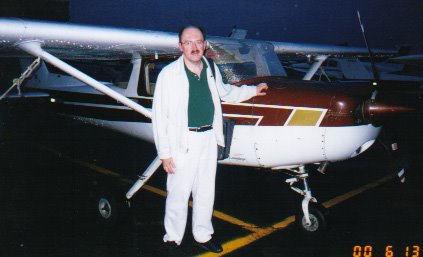 At the end of this lesson, I discussed the solo plan with Mario. He basically said that NEXT lesson (tomorrow!) we will do pattern work, and he will say and do nothing (short of a real emergency), sort of a pre-solo final exam. He will also give me the pre-solo written test to take home and do, and on the next lesson (soon!) he will grill me on the questions, take me up for a T&G and full-stop, and sign me off for solo! So I am really REALLY close and with luck (weather mostly - crosswinds my big problem), I will solo in the next few days, just short of 30 hours TT (time to switch to a new flight lesson notes file then too).
Today was a two-parter, and fairly long as my recent lessons have been (we seem to have lost the "one hour to stay fresh" idea, though 1.2 or 1.3 is not bad). The first part was in the west practice area, for my first 0.2 hours of simulated IFR, wearing foggles rather than a hood (I could actually see quite a lot of the side and front views). He had me do level flight, turns to specific headings, climbs and descents, with and without turns. I did OK on this stuff (sim experience may actually help on this sort of stuff). I overshot my headings and gained or lost as much as 150 feet (100 is the practical tolerance), but overall not too bad. It was a bit bumpy in spots, but I did OK, didn't overcorrect for it, just rode out the bumps. Things to remember:
• Stay coordinated - step on the ball!
• Don't exceed 30º of bank (standard rate turns in IFR).
• Roll out ahead of the target heading.
• Level off ahead of the target altitude, 10% of the climb rate (50 feet lead for 500 fpm climb or decent).
• Pitch, power, TRIM!!!
• Keep the scan up (I think I did OK on this -- did not seem fixated on the attitude indicator).
I actually liked the IFR stuff, but may try the hood next time.
Then we went back to the airport to practice touch and goes. Flew over town of Spencer to set up the mid-field left downwind for runway 29 (Mario said my pattern entry and setup was "perfect"). Did most of the radio calls except when there were calls to watch traffic and to be #3 after specified traffic which I had to spot and report (lot of traffic today, including two other students doing T&G's, with right as well as left traffic active in the pattern -- controller was busy today). Winds were pretty good, sometimes at 290º, straight down the runway, but I had a crosswind on some landings. I did one really smooth landing, the first one I think, probably my first "greaser." The others were "firm" but I recovered them well, re-flared and held the nose off. Some points:
• WATCH THE WIND ON TAKEOFF - with a wind from the left, I usually had the yoke turned RIGHT at the liftoff point, adding to the wind drift, a mistake. Need to establish the crab INTO the wind as soon as the wheels are off the ground.
• In the pattern, I did pretty well with altitude control, though I still don't have a good feel for when I need to turn greater or less than 90º in my pattern turns due to wind effects.
• Still slow on base and final sometimes (final was usually OK, 65 knots, often 60-65 on base). Mario is still foggy on why I get slow (me too!), but he did mention the need to get the nose down when you add flaps.
• Early lineup was better, and I held the lineup better on most passes, and when I drifted off, I did the corrections myself. Poor wheel alignment on some landings (need to control the airplane all the way down!).
• REMEMBER CARB HEAT midfield when I make the radio call - I forgot a couple of times, though I remembered flaps every time (only used 20º because of the strong headwind on final, low ground speed with full flaps, and also needed to keep speed up due to heavy traffic in the pattern).
• Getting a little better on trim in the pattern.
• WATCH THE TAIL WIND (fast ground speed) on downwind leg -- it went fast and my radio calls were late sometimes (also a lot of radio traffic today, so I had to avoid stepping on others' transmissions).
• IMPORTANT: After touchdown, FLAPS first, then carb heat IN, then full power for takeoff (I skipped the flaps once - dangerous since you can sink when you lose their extra lift, don't want to be airborne before flaps are fully retracted!).
• RIGHT RUDDER for full power climb - keep that ball centered better.
• I was not consistent on the length, altitude, and descent rate for my end-pattern (from abeam the numbers to base to final). Some of this was due to ATC and traffic spacing (slow flight, extend downwind, etc.), but some was just poor airspeed control by me, though Mario commented that I did a nice job each time correcting for the problem and getting the airplane aligned and down. Generally I was high at the start, which is better than low.
• Need to pick my touchdown spot sooner and REALLY aim for it.
• IMPORTANT: Need a review on how to forward slip on final when I end up too high and with less than full flaps!
Overall, a good lesson, and I think I'm justified in pushing Mario a little on the solo plan -- I'm just about ready. I still have this feeling of odd inconsistency -- some things I really have a good feel for (like correcting for various starting points for final, high or low). But other "simple" things seem to escape me sometimes (like which way to bank and press rudder to line up the nose on short final!!!). But the good news is this: I can land the airplane! Not always perfect, but I can land it.
Time: 1.3 hrs dual, TT 27.3 hrs, C152 at ORH
Monday, July 17, 2000
Getting the Green Light (Lesson #22)
This was a pretty good lesson considering the week off and the crappy weather. There was a slight but noticeable crosswind, and we stayed in the pattern in N47261, which is the underachieving C152 (climbs like a bumblebee). Started out with runway 11 and did OK on takeoffs (some drift) and pattern (crabbing for wind MOST of the time). Landings were a little rough, but I flared and got the plane down, even with some wind correction.
IMPORTANT NOTE: When I bounce, I have a tendency to lower the nose to try to paste it on the runway. BAD MOVE. When you bounce, you are still flying and have to land AGAIN. You don't want to land on the nose wheel. KEEP THE NOSE UP AND ADD SOME POWER IF NECESSARY. Also, TRACK ALONG THE RUNWAY -- I put some bad side loads on the gear last night. AND THINK ABOUT THE WIND. Use ailerons for drift, straighten the nose WITH THE OPPOSITE RUDDER. I got confused on the proper rudder to apply and/or I let off on the correction too soon.
Another thing is speed. I'm still getting slow sometimes and I don't really know why. It should be easy -- 75 downwind, 70 base, 65 final, boom. Once established, I do a lot better if I just look at my landing spot and BARELY GLANCE at airspeed.
There were a lot of jets around last night, and at one point a Hawker was slowly back-taxiing to get to the end of the runway (they want all 7000 feet I guess). I was on downwind, so the tower (Dave, he's a student pilot too -- should see if I can visit up there some time) told us to do a 360 when abeam the numbers then report back when abeam again. This gave the Hawker time to get in place and take off (caution wake turbulence). Pretty cool! Mario handled the radio on this part -- I didn't expect it and wasn't sure what to read back. Mario also asked the tower to give me a light signal before the first takeoff (green - clear to take off, clear to land if airborne). He wanted me to see what it looks like -- good idea. I need to memorize the signals (I know them well enough for the multiple choice FAA questions).
Finally we had to switch runways from 11 to 29 by doing a right 90 followed by a 270 onto the new runway heading. Mario did the radio on this one, but we agreed that it was good to have seen a couple of these ATC-ordered pattern spacing maneuvers before I solo. Another student told me he got two of these on his first solo and had never seen them before -- he just wanted to land! He's got 37 hours and is almost ready for his check ride (needs night x-country and long solo x-country, figures he'll complete in 43 hours, wow!). He was a 20-something heading off to Embry-Riddle Aeronautical U in Florida to train as a commercial pilot, and he wanted to complete his private before enrolling. I could have probably learned faster in my twenties, too. But all in good time, grasshopper. Mario told me to study the Part 61 & 91 student pilot/solo regs before Saturday's flight, so maybe…
Time: 1.2 hrs dual, TT 26.0 hrs, C152 at ORH
IMPORTANT NOTE: When I bounce, I have a tendency to lower the nose to try to paste it on the runway. BAD MOVE. When you bounce, you are still flying and have to land AGAIN. You don't want to land on the nose wheel. KEEP THE NOSE UP AND ADD SOME POWER IF NECESSARY. Also, TRACK ALONG THE RUNWAY -- I put some bad side loads on the gear last night. AND THINK ABOUT THE WIND. Use ailerons for drift, straighten the nose WITH THE OPPOSITE RUDDER. I got confused on the proper rudder to apply and/or I let off on the correction too soon.
Another thing is speed. I'm still getting slow sometimes and I don't really know why. It should be easy -- 75 downwind, 70 base, 65 final, boom. Once established, I do a lot better if I just look at my landing spot and BARELY GLANCE at airspeed.
There were a lot of jets around last night, and at one point a Hawker was slowly back-taxiing to get to the end of the runway (they want all 7000 feet I guess). I was on downwind, so the tower (Dave, he's a student pilot too -- should see if I can visit up there some time) told us to do a 360 when abeam the numbers then report back when abeam again. This gave the Hawker time to get in place and take off (caution wake turbulence). Pretty cool! Mario handled the radio on this part -- I didn't expect it and wasn't sure what to read back. Mario also asked the tower to give me a light signal before the first takeoff (green - clear to take off, clear to land if airborne). He wanted me to see what it looks like -- good idea. I need to memorize the signals (I know them well enough for the multiple choice FAA questions).
Finally we had to switch runways from 11 to 29 by doing a right 90 followed by a 270 onto the new runway heading. Mario did the radio on this one, but we agreed that it was good to have seen a couple of these ATC-ordered pattern spacing maneuvers before I solo. Another student told me he got two of these on his first solo and had never seen them before -- he just wanted to land! He's got 37 hours and is almost ready for his check ride (needs night x-country and long solo x-country, figures he'll complete in 43 hours, wow!). He was a 20-something heading off to Embry-Riddle Aeronautical U in Florida to train as a commercial pilot, and he wanted to complete his private before enrolling. I could have probably learned faster in my twenties, too. But all in good time, grasshopper. Mario told me to study the Part 61 & 91 student pilot/solo regs before Saturday's flight, so maybe…
Time: 1.2 hrs dual, TT 26.0 hrs, C152 at ORH
Sunday, July 09, 2000
Learning to Land (Lesson #21)
This was an awesome lesson. Wind was very calm first thing in the morning (I called ATIS and ASOS from home) so I didn't have to sweat the crosswind stuff, just concentrate on flying a solid pattern, good approach, and FLARE. I've just about got that part now, though I still have a tendency to stray from the centerline at the very end and to relax my control of the airplane once it's on the ground (but still rolling and maybe even before the nose wheel is down). I'm also still a flying a bit slow on base and final (get the nose down!!!), but I could possibly solo next lesson if it's calm.
I experienced a lot of stuff today, in nine landings (all touch and go but the last, no go-arounds, no Mario saves):
· Simulated engine out -- "lost your engine" on downwind near the numbers -- Mario pulls idle power. First try I set best glide but still "squared off" the pattern and needed to add power to reach the threshold. BAD MOVE. Set best glide (65 knots) and HEAD FOR THE RUNWAY NOW (then communicate with ATC if there's time, "request priority landing, engine out emergency"). Second time I made it with plenty of room.
· Patterns with NO instruments. I did three or four of these. Mario covered up EVERYTHING, even the tach. I flew smoother this way (don't be a slave to the instruments in VFR!), though I was high on one landing, and Mario demonstrated a forward slip (this was probably a Mario save, can't remember). Nice to know I can fly a reasonable pattern and approach in pure "seat of the pants" VFR.
· No flaps landing -- did one or two of these -- come in shallow and faster than normal. Landed at maybe 70 knots. Not bad, not really any harder than normal as long as there's no crosswind.
· Had to expedite one turn to crosswind because a jet was ready to depart. Watched it take off from the downwind leg, a nice view. First time I've gotten "caution, wake turbulence" from ATC -- not a factor since we touch down and take off in the first 3000 or 4000 feet of runway and the jet lifted off at 5000+ feet.
Mario felt I made real progress on both this and the Friday lesson - me too. I'm really landing the airplane (as long as there's a minimal crosswind). Cool. Remaining problems -- still slowing too much on base and final, often around 60 instead of desired 70 then 65. What's up with this? And I get a bit confused on controls when I start to drift near touchdown -- don't want to bank much down here, use rudders more (and correctly). Better to get the corrections in earlier when they are smaller! Thank goodness for the wide runway. But I was very close to centerline on most of the landings. The flares were pretty decent -- a bit hard on a couple, a bit floaty on a couple more. But overall, a great lesson. I feel really comfortable in the airplane now.
Oh yeah, I also need to MEMORIZE the control positions for taxiing with wind! This is important in the feather-weight C152. I still get confused on this and when I'm holding the yoke, my hands want to steer with it, even though my feet know that this is their job. Useful tip: Use the heading indicator to visualize where the wind is with respect to the airplane. If it's coming from 320 degrees, use the directional gyro to show where it is coming from as you steer around the airport. Another thing: requesting "the option" from the tower means (if cleared for it) that you have the option for touch and go, go around, simulated engine-out approach, or full-stop landing. Only request this when the pattern is pretty free of traffic -- common courtesy to other pilots.
Time: 1.3 hrs dual, TT 24.8 hrs, C152 at ORHFriday, July 07, 2000
All But the Flare (Lesson #20)
This one looked like it might not happen at all. With only 29/11 available due to construction on 33, crosswinds are normal, but AWOS/ATIS sounded bad. They had 350º at 19 knots, gusting to 26, variable 340-020º which gave a crosswind component of 16.5 knots, which exceeded the demonstrated 12 knots for the C152, though Mario said HE could do it, carry more speed and use minimal flaps. But me??? We briefly considered Fitchburg, 10 minutes NE with a runway 32, but it turns out the C152 had only half-full tanks, so no-go. We called weather again and the winds seemed to be calming, so we went for it.
We ended up doing 9 landings, and on the first 4 I managed to learn to recognize my wind drift and fly a wind-corrected pattern fairly well. I held my speed better too, though I need a lot of work on control positions for taxiing the airplane! The first few approaches were all over the place, but then I finally started to get it and managed to hold right yoke and left rudder and pitch to keep the approach spot fixed on the windscreen. Mario said "you're getting this!"
The trouble was the flare - still no clue on when to start it and how fast and how much to pull. Mario did the first few with a rushed "my airplane" each time. The last 2 or 3 were me, but my one full landing was REALLY hard on the right wheel. Mario used the long runway to make it look easy to roll along the centerline on the upwind (right) wheel, but I could not control it that precisely. But everything else was working at the end. We even had to switch to right traffic to clear the way for an incoming Dash 8 from the south (new American Eagle flights to/from JFK I guess). This was tough the first time (right wing hides your ground references), but I did OK, though sometimes I would forget the crab and just get parallel to the runway, then drift too close. This means that with the fast ground speed on the turn to base, I had only a second or two to get flaps in and turn final. On one of these, I was really slow and Mario took the airplane and did a couple of steep turns to get us lined up.
A couple of times we took an extended downwind to give me more time on final to get established. This helped. After the lesson, Mario was very encouraging, said I made real progress on all but the flare. Tomorrow morning (0700!) we will work on that part. Solo will be… when I'm ready! But I'm getting close. One thing that helped on final (oddly enough) was the sun -- it was low and straight ahead for approach to 29 so I could barely see the instruments. This meant I had to look outside (to hold the touchdown point fixed on the window), which was better for me anyway! I tried to explain some of my perceptual difficulties to Mario at the start of the lesson (I know I should see that drift, but I don't!), and it also helped to discuss and diagram the likely wind picture on the ground before we flew -- I was starting to visualize it, and plan for it.
We did encounter wind shear on a couple of approaches. I was holding right yoke and left rudder and had a good line up when suddenly it went bad. I'm thinking, what did I screw up? But Mario explained that the wind shifted just then so you just adjust to what you see. He emphasized that I CAN control the airplane, I'm the pilot, so don't be afraid to make it do what you want. I'm getting there!!! We took a few pictures too -- there were some awesome clouds out there, including some towering cumulus or thunderstorm clouds with flashes of lightning underneath way east, near Boston.
Time: 1.3 hrs dual, TT 23.5 hrs, C152 at ORH
We ended up doing 9 landings, and on the first 4 I managed to learn to recognize my wind drift and fly a wind-corrected pattern fairly well. I held my speed better too, though I need a lot of work on control positions for taxiing the airplane! The first few approaches were all over the place, but then I finally started to get it and managed to hold right yoke and left rudder and pitch to keep the approach spot fixed on the windscreen. Mario said "you're getting this!"
The trouble was the flare - still no clue on when to start it and how fast and how much to pull. Mario did the first few with a rushed "my airplane" each time. The last 2 or 3 were me, but my one full landing was REALLY hard on the right wheel. Mario used the long runway to make it look easy to roll along the centerline on the upwind (right) wheel, but I could not control it that precisely. But everything else was working at the end. We even had to switch to right traffic to clear the way for an incoming Dash 8 from the south (new American Eagle flights to/from JFK I guess). This was tough the first time (right wing hides your ground references), but I did OK, though sometimes I would forget the crab and just get parallel to the runway, then drift too close. This means that with the fast ground speed on the turn to base, I had only a second or two to get flaps in and turn final. On one of these, I was really slow and Mario took the airplane and did a couple of steep turns to get us lined up.
A couple of times we took an extended downwind to give me more time on final to get established. This helped. After the lesson, Mario was very encouraging, said I made real progress on all but the flare. Tomorrow morning (0700!) we will work on that part. Solo will be… when I'm ready! But I'm getting close. One thing that helped on final (oddly enough) was the sun -- it was low and straight ahead for approach to 29 so I could barely see the instruments. This meant I had to look outside (to hold the touchdown point fixed on the window), which was better for me anyway! I tried to explain some of my perceptual difficulties to Mario at the start of the lesson (I know I should see that drift, but I don't!), and it also helped to discuss and diagram the likely wind picture on the ground before we flew -- I was starting to visualize it, and plan for it.
We did encounter wind shear on a couple of approaches. I was holding right yoke and left rudder and had a good line up when suddenly it went bad. I'm thinking, what did I screw up? But Mario explained that the wind shifted just then so you just adjust to what you see. He emphasized that I CAN control the airplane, I'm the pilot, so don't be afraid to make it do what you want. I'm getting there!!! We took a few pictures too -- there were some awesome clouds out there, including some towering cumulus or thunderstorm clouds with flashes of lightning underneath way east, near Boston.
Time: 1.3 hrs dual, TT 23.5 hrs, C152 at ORH
Monday, July 03, 2000
A MiG At Your Six (Lesson #19)
 Of course I didn't literally have a MiG at my six, but to paraphrase an alleged fighter pilot quote ("A MiG at your six is better than no MiG at all"), having landing problems is actually good because it means I am learning to land an airplane, something I have always wanted to do and something for which I am clearly not overly gifted. I know I can learn to do it, but it may take a bit longer! So relax and enjoy the ride. The real title of this note should have been "crosswind blues."
My real problems are consistency and multitasking. I was frustrated again tonight by my inability to implement stuff I know how to do, and have done in previous lessons. When it comes to smooth execution of the final 30 seconds or so from starting base to (almost!) landing -- that's where it breaks down for me. Paying attention to multiple things at once and remembering and executing the procedures. Tonight there was a substantial cross wind, and I thought I had the side slip technique, at least in concept. Wing low into the wind, point the nose down the runway with the rudder. The part I missed until attempt #4 was to HOLD the left aileron and to HOLD the right rudder the whole time (on final -- probably should crab first then transition to this since being cross-controlled down low with my tendency to get slow is a classic stall-spin set up -- need to discuss this with Mario). The thing is, it's not like a normal bank where you neutralize controls after establishing the desired bank. You find out what position of yoke and rudder straightens your path and alignment and HOLD THEM IN!!! Only adjust it if you overshoot or the wind changes or gusts.
I did not get this on three attempted touch and goes, and ended up drifting all over the width of runway 29 (150 feet wide!). On the last attempt, I had the control ALMOST (slight drift), but I basically forgot to flare, so Mario did this. He executed the go-around on the first three attempted T&G's. Good thing the airport was empty (as usual on a MVFR semi-rainy evening). So it was not my day, but nobody said I was Chuck Yeager, and Mike Love (not the Beach Boys' Mike Love, but the CFI author of a book I have called "Flight Maneuvers") says that cross wind landings require finesse and practice. Well, I'm working on part deux anyway! Mario is very patient and encouraging, though I sometimes wish he were a little more critical and a little better at diagnosing what I am doing wrong. We ended at 0.9 hours just when I started to get the slip procedure, but the weather had dropped below VFR with visibility under 3 miles, and the tower was having trouble keeping us in sight. Time to go home! As I taxied off the runway, a female deer was on the grass 50 feet to the right. She ran away when I gunned the engine to start taxi after doing the checklist.
N47261 is a pretty crummy little plane. Weird noises, barely climbs, barely keeps running in the idle check (with carb heat) at runup. At least they replaced the nearly bald right main tire before our flight today (we were the test pilots for this work, but I figure if the mechanics can't replace a tire correctly, we're in trouble on a lot of other stuff - I did a thorough preflight and checked the bolts, pins, and brakes carefully on that wheel). Try to get 661 next time!!!
Silver lining department: OK, so the crosswind landing thing needs a lot more work. Not to mention the basic landing thing. But look on the bright side:
• I'm flying -- it's not an F-16, but when I call the tower (nearly perfect on my radio work, Mario says), get "clear for takeoff," push full power, and take off, it's still VERY cool. Look, Ma, I'm flying the airplane!
• I'm doing many things pretty smoothly and consistently -- preflight, run up, radio work, taxi, takeoff, trim, climb out, straight and level, and pattern turns are all pretty good.
• Wind is a bitch. This is one area where sims may have hurt me a bit. Most combat sims have no wind model, and in a fast jet, typical winds are a minor correction anyway (though important in long range navigation, most of the time you just follow the waypoint caret anyway, and any wind correction is probably factored in by the nav system). At 65-75 knots in the pattern, a 5 or 7 knot cross wind is a big vector for a C152. And even thinking about the wind is hard for me, very abstract -- you can't see it directly, you have to learn to infer it from the airplane's behavior, although the reported wind gives you some clue of what to expect. I am starting to get the wind idea, crabbing and slipping and all.
• Rome wasn't built in a day. OK, so I had some early flight experience in the Piper Cub (no landings though), and I have years of sim experience (mostly in combat jets with questionable flight modeling and little attention paid to precise patterns, navigation, etc.). But I still have to learn to fly the real airplane in the real wind with the real instruments and controls, and I have to learn it at my own speed. Some lessons will feel like progress, others won't. But it's fun all the same to be doing this. There's nothing I want to do more! Before too long I will be a pilot, and I won't have this dream any more (I'll replace it with an accomplishment and probably set some new goals, like an instrument rating, aerobatics training, or
One last thing. PREPARE. I did do some reading on landings and stuff yesterday, but I didn't review my notes on past lessons and mistakes, and I still don't have the instrument/outside scan and pattern procedures down cold. They should be smooth and continuous, not sequential. Things happen quick up there, even at a paltry 70 knots. I could even rehearse the steps in my car or in a chair, with or without a sim. The mental game of flying!
The consistency will come with practice -- I have 22 hours now, but only 4 of them are very recent. Flying at least once a week will help with this too.
Time: 0.9 hrs, TT 22.2 hrs, C152 at ORH
Sunday, July 02, 2000
Rust Never Sleeps (Lesson #18)
Even after flying around the world in economy class, I was ready to once again take the even more cramped left seat of a C152. The 2+ week layoff really hurt me, as did the 2+ hours hanging around the FBO for the flight (1:00 scheduled, but shit happens as usual -- but by the time I flew I was feeling time pressure because I had to pick up J & C and take them places). Not Mario's fault, but it gets annoying sometimes. ANYWAY, it was clear and warm, about 85 F, and with full fuel tanks and close to 400 lbs of adults on board, the C152 was a bit sluggish. We could barely get 400 FPM out of it. Runway was 29, winds 270 at 5 or so. Crosswind picked up as we got back for landings.
Preflight was fine, got ATIS (which expired while I was fumbling through the checklist, Charlie went to Delta) but I made the radio call to ground early, before I had completed the pre-taxi checklist. READ AND FOLLOW CHECKLISTS. That should be so easy, but I get sloppy, in a rush to get going. Bad plan! My radio calls were good, overall. Taxi this time with wind-awareness -- left quartering tail wind -- REVIEW YOKE POSITION FOR TAXI WITH WINDS. Takeoff was pretty good, I tracked the 290 degree departure heading pretty well and trimmed for my 67 knot climb (later slowed to Vx around 60 kts to try to get better climb rate). Straight out departure to the vicinity of Spencer, and I knew where to expect Spencer Airport when Mario asked me, good checkpoint awareness. Bit of turbulance around 3000 feet.
First up (my request) was slow flight, and I was sloppy. Started by NOT doing a real clearing turn. Slowed to approach speed and configuration and did some shallow turns. So-so on these -- poor altitude, heading, and rudder control. We did these for maybe 15 minutes before heading back to ORH for some pattern work, two T&G's and a full-stop. These were VERY sloppy. Pattern was OK, I'm really OK up until the key position, but there I always start to let my speed drift, and I'm not well-trimmed for the speeds I need (75 downwind, 70 base, 65 final). My turns were VERY sloppy and I overshot the turn to final each time, partly due to the wind.
Crosswind was also a pain on final -- trying to slip, bank into wind and straighten ground track with rudder, but VERY sloppy on this. I guess I really don't "get it" as far as real action on the crosswind. Flare was high each time, and I bounced and drifted laterally, with Mario needing to take the airplane on one landing, the others saved by me (adding power at M's prompting). Mario said I did fine, but it didn't feel so great. But tonight I have another lesson at 7 and we will stay in the pattern and I will get this landing thing figured out!
Time: 1.1 hrs, TT 21.3 hrs, C152 at ORH
Preflight was fine, got ATIS (which expired while I was fumbling through the checklist, Charlie went to Delta) but I made the radio call to ground early, before I had completed the pre-taxi checklist. READ AND FOLLOW CHECKLISTS. That should be so easy, but I get sloppy, in a rush to get going. Bad plan! My radio calls were good, overall. Taxi this time with wind-awareness -- left quartering tail wind -- REVIEW YOKE POSITION FOR TAXI WITH WINDS. Takeoff was pretty good, I tracked the 290 degree departure heading pretty well and trimmed for my 67 knot climb (later slowed to Vx around 60 kts to try to get better climb rate). Straight out departure to the vicinity of Spencer, and I knew where to expect Spencer Airport when Mario asked me, good checkpoint awareness. Bit of turbulance around 3000 feet.
First up (my request) was slow flight, and I was sloppy. Started by NOT doing a real clearing turn. Slowed to approach speed and configuration and did some shallow turns. So-so on these -- poor altitude, heading, and rudder control. We did these for maybe 15 minutes before heading back to ORH for some pattern work, two T&G's and a full-stop. These were VERY sloppy. Pattern was OK, I'm really OK up until the key position, but there I always start to let my speed drift, and I'm not well-trimmed for the speeds I need (75 downwind, 70 base, 65 final). My turns were VERY sloppy and I overshot the turn to final each time, partly due to the wind.
Crosswind was also a pain on final -- trying to slip, bank into wind and straighten ground track with rudder, but VERY sloppy on this. I guess I really don't "get it" as far as real action on the crosswind. Flare was high each time, and I bounced and drifted laterally, with Mario needing to take the airplane on one landing, the others saved by me (adding power at M's prompting). Mario said I did fine, but it didn't feel so great. But tonight I have another lesson at 7 and we will stay in the pattern and I will get this landing thing figured out!
Time: 1.1 hrs, TT 21.3 hrs, C152 at ORH
Tuesday, June 13, 2000
Starting to Get It! (Lesson #17)

It was cloudy and light rain at ORH, but when I called Mario, he said OK as long as we stay in the pattern (low ceiling, clouds coming in, but still VFR). So we did, and I had a GREAT lesson! I did 6 touch-and-goes and one full stop landing, and two of them were actually pretty good. The others were bouncy, high-flare jobs, but Mario only had to take over on one of them (I added power to salvage one bouncer myself). I felt good, felt like I was actually doing most of the things I know I should do. I was fairly relaxed and felt in control of the airplane and myself. And Mario says I'm just about ready to solo! He said I was really flying the airplane out there last night. One or two more lessons and we will get that psychological barrier and life milestone out of the way. Unfortunately this will be in early July since I leave Saturday for my Korea to Germany business trip (around the world on UA and LH).
The good news items include:
• Followed checklists in detail this time, preflight, engine start, run-up, etc., no skipped steps or backtracking.
• Handled all the radio calls myself, from taxi to landing, including the base call for each touch-and-go.
• Good taxiing -- stayed on the lines (remembering that the reference point is in front of MY eye, not the center of the cowling).
• Good takeoffs -- nice rotation, trim, hold 67-70 knots, stayed aligned with the runway heading until crosswind turn at 1700 feet.
• I remembered and followed all the pattern steps with almost no prompting.
• I used trim much better, especially on climb-out and level off for the downwind leg. With this, I was able to fly with a very light touch and no PIO. This also helped me to stay quite close to pattern altitude (2000') once I got there.
• My patterns were reasonably rectangular and I sometimes corrected for the slight crosswind, though I varied on this. Used shallow turns, none over 30 degrees, and rolled out aligned with the runway on most approaches.
• I noticed the spot on the windshield that did not move on touchdown.
• Looked down the runway for flare height cues (but didn't read them right most of the time!).
• Good takeoffs on the touch-and-goes -- get flaps up, carb heat off, full power, steer with small corrections. I did swerve a bit sometimes, and I kept too much weight on the nose wheel sometimes, leading to a dreadful rumbling.
• Did not get flustered when we passed briefly through a cloud on downwind -- I just watched the attitude indicator.
The BAD news items include:
• Poor airspeed control on base and final -- need 70 knots on base, 65 knots on final, and I was not trimmed for this AND I chased the airspeed indicator when I was off speed. Need to pay more attention to the outside cues, where the nose is, and NOT get slow on final (e.g. 60 kts). Being stabilized on final will help the flare too, less variation to worry about.
• Got close to runway on downwind a couple of times, leading to a rushed turn to base and then final -- a carrier pattern! But this didn't give me time to handle flaps, radio, lineup, and air speed stabilization without feeling rushed. Part of this was the tower's request that we keep a tight pattern so he could keep us in sight (clouds were coming down) - Mario says on a better day, we could extend the downwind.
• High flare! I still start to get nervous with the "ground rush" in the last few seconds, worrying that I will land on the nose wheel, though I am still pretty high. This will come with a bit more practice and a stabilized final.
• Poor wind awareness -- I corrected for the wind sometimes but still didn't fully grasp what it was doing to me on each leg. It was not a bad wind, from 100º at 7 knots, while we were using runway 11 (110º), so it was just off by 10º from the left. Mario gave me a tip, not sure how general -- 100º wind direction was LESS than the 110º runway heading so crosswind was LEFT. Have to think about this one for other directions! It actually seems wrong based on the picture I just drew - LOOK THIS UP!
• Last landing was AWFUL -- bounced so much Mario said it should count as three landings. He said this often happens after a good session with touch-and-goes, on the full-stop landing the student loses focus and does a real stinker. Oh well, he said the total lesson was really quite good.
• Consistency! This is a major thing -- still a lot of variation and times when I fail to do things I know I should do AND know how to do. But this is part of the learning process too, and very typical. It's also related to confidence -- knowing I can do something, feeling free to make adjustments, not hesitating or always checking with the CFI. Mario says that the solo helps this too -- once you have experienced being the only "pilot in command," you know you can do it, and it makes it easier to learn the rest.
I am far from perfect, but with this lesson, the good news outweighs the bad, and I feel like I finally am really starting to "get it." Landing an airplane is starting to feel like a normal thing to do. I think I should be able to solo after maybe two more lessons (one to catch up after 2+ weeks away, then final prep and solo).
Time: 1.1 hrs dual TT 20.2 hrs, C152 at ORH
Monday, June 05, 2000
Pattern Work at ORH (Lesson #16)
 One good flight deserves another, right? Well, the next couple of weeks will be busy, so I decided to take another lesson yesterday -- nothing for 10 months then two in two days! We got another late start on the scheduled 7 pm lesson and decided to stay in the ORH pattern (landing runway 11 this time, vs. 29 yesterday). This means we were landing a little south of east, 110º -- there was a crosswind from the north, so I had to crab to the right on the downwind, angling slightly north of the nominal 290º downwind heading to keep from toeing in and crowding the runway on downwind (something I tend to do anyway). It also increased my ground speed on base (tail wind) which contributed to my late turn to final (something I tend to do anyway!). I was so wide on the first one that I did a go-around (I tried to parallel the runway like an "upwind leg" but Mario told me I should be right over the runway for a go-around, so I flew over there). Good thing there was no other traffic there last night!
 I never really "visualized" this crosswind, and I think this is what made my landings so rough. Since I was going EAST on final with a wind from the NORTH (left to right), I needed to crab into the wind to have the correct ground track -- bank to the left. Mario wanted me to hold in this bank (left yoke) and straighten the nose to track straight ahead by using RIGHT RUDDER. I more or less did this, but with overshoots and corrections, I was swinging all over the runway (good thing it's so wide). We did maybe five touch-and-goes, with Mario calling the tower to report left base each time (I was too task-saturated to think about the radio calls -- once he was so busy explaining something that he forgot to call base and got a mild reprimand from the tower -- "you seem to be on final, you can go ahead and land if you want" -- that's a real no-no at a controlled field, but it was otherwise dead there -- the controller was cool about it and Mario apologized).
Meanwhile it was getting dark (picture is from the Fly! simulator), another first for my flight lessons -- the last two were basically night landings. On all of the pattern work, I was quite tense and this showed on the yoke, PIO all over the place (pilot induced oscillation). As usual, when I'm busy I forget about trim, and I also notice overshoots late and tend to jerk the yoke back to where it should have been -- bad move! Things to remember and do:
· Use trim all the time! Trim is your friend! Establish the 67 knot descent near the end of the downwind and hold with trim. When off trim, I tend to get slow (nose high) then over-correct pushing the nose down. You don't want to be slow on base and final at 1000 feet AGL or less!
· Don't over-bank in the pattern -- 30º max, 20º even better!!! This isn't an F/A-18 carrier break!
· Think about the wind -- get a mental picture!
· Smooth, small inputs on the controls.
· Look to the end of the runway for the flare cues!
· Memorize the pattern procedure -- carb heat, power setting, descent, sight picture!
· Work on my instrument/outside scan! I tend to fixate on one or two things at a time.
· Memorize go-around procedure and the emergency procedures Mario gave me.
I felt very overwhelmed and not very slick last night especially when Mario had to save a couple of the landings after a big bounce, but he said I'm doing fine for this stage, typical problems, and I'm not that far from solo. We need to work more on pattern and landings of course, and also on emergency procedures. He wants to put me under the IFR hood for a bit too, since I've never done that and it's important if you end up in a cloud. Somehow he seems more down to earth, patient, and positive than Kern -- I like him better as a CFI. I also bought a POH (handbook) for the C152 and my own fuel-tester. Yesterday I also got the E6B flight computer I ordered from Sporty's -- I prefer this over the slide rule thingy for the various calculations you need for flight planning. On my Korea trip, I will concentrate on completing the FliteSchool CD-ROM ground school course so I can take the written test in July. Depending on weather and other schedule factors, I hope to get 6 to 10 lessons in by September and solo the airplane. I will put $1000 in an account at Amity so I can get the $50 "club rate" on the C152 rather than the $56 standard rate.
Meanwhile I decided to return the Saitek X36 stick/throttle set I bought last week, as cool as it is. I'll replace it with the new CH Flight Yoke LE USB (about $90 on the web), which will be much more realistic with Fly! I'll try using the existing CH Pedals with it (works OK with the Logitech though it's very jerky in the calibration screen), though I may later buy the USB Pro Pedals which include toe brakes (Fly! supports these). I think I can even work on pattern stuff that way -- set my RPM, watch my descent, put in a cross wind and crab or slip against it. Some of this is just getting the procedure to be totally routine, and I think Fly! is close enough to reality for this (though it's fuel-injected C172R with no carb heat to pull, vs. the 1980 C152 we are flying IRL - no biggy).
Subscribe to:
Posts (Atom)